Blog Details
Detailed view of the selected blog post.

Detailed view of the selected blog post.
Artificial Intelligence is no longer something limited to science fiction or technology companies. It is already becoming a part of everyday life. From mobile apps and online payments to healthcare, defence, education, and cybersecurity, AI is slowly influencing how societies function and how decisions are made.
Time: 06 min
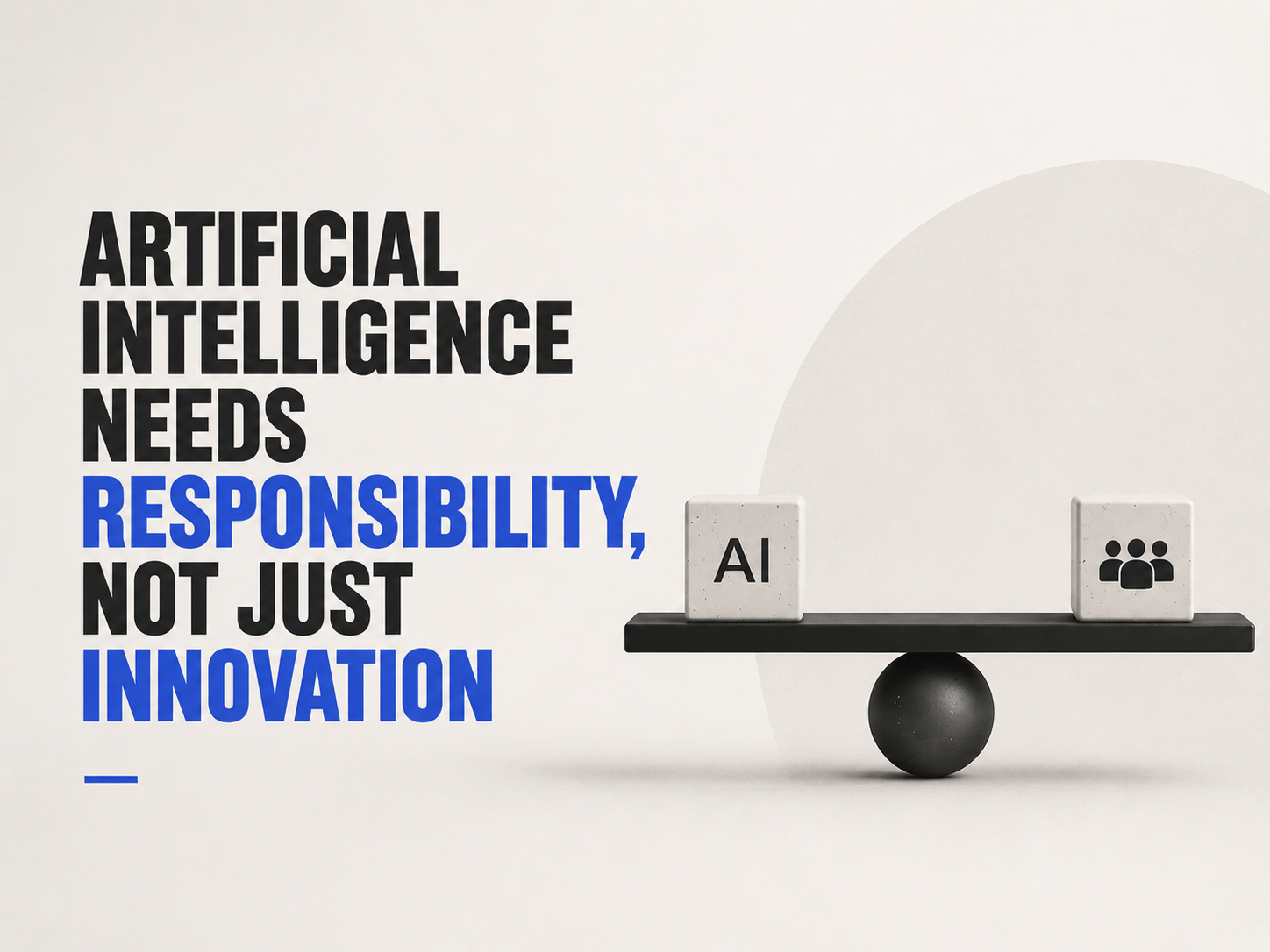
Innovation without responsibility is just risk.
As AI systems become more powerful, an important question is also becoming more serious:
Who controls Artificial Intelligence, and how should it be used responsibly?
For years, most discussions around AI focused mainly on innovation and technological progress. But now, governments, organisations, and experts across the world are increasingly discussing something equally important; governance, ethics, accountability, and safety.
The concern is simple.
Technology is growing faster than the systems designed to regulate it.
Unlike older technologies that remained limited to one country or region, AI systems can affect millions of people globally within a very short time.
A technology developed in one country can influence:
across multiple countries at the same time.
This creates new challenges for governments and institutions.
Questions are now being raised about:
As AI continues becoming more advanced, countries are slowly realising that innovation alone is not enough. Rules, safeguards, and accountability are equally necessary.
One major problem is that technology develops much faster than laws and policies.
AI systems are evolving rapidly, while governments and international organisations are still trying to understand how these systems should be regulated properly.
Different countries are currently approaching AI governance differently.
Some focus heavily on innovation and economic growth.
Others focus more on safety, privacy, and ethical concerns.
This creates a complicated global situation because AI does not remain restricted within national borders.
There is currently no single global system controlling how AI should operate internationally. Instead, multiple countries and organisations are attempting to create their own frameworks, guidelines, and regulations.
The challenge is finding a balance between:
Many students think Artificial Intelligence matters only for engineers or technology professionals.
That understanding is incomplete.
AI is becoming a leadership issue as much as a technology issue.
Future military officers, administrators, policymakers, and strategic leaders will increasingly work in environments influenced by AI systems. Modern warfare, cybersecurity, intelligence analysis, logistics, surveillance, and communication systems are already becoming technology driven.
In the future, leaders may need to answer difficult questions such as:
These are not purely technical questions.
They are leadership questions requiring judgement, ethics, balance, and responsibility.
One of the biggest concerns surrounding AI is that powerful technology without ethical control can create serious risks.
Artificial Intelligence systems are trained using massive amounts of data. If the data itself contains bias, discrimination, or misinformation, the AI system may also produce unfair outcomes.
Similarly, AI can be used positively for:
But the same technology can also be misused for:
This is why ethics and accountability are becoming central to AI discussions worldwide.
Technology itself is not automatically good or bad.
Its impact depends on how responsibly human beings use it.
Artificial Intelligence is becoming an increasingly important topic in:
However, the purpose is not simply memorising definitions or technical jargon.
Assessors are more interested in whether candidates can think logically and form balanced opinions on important national and global developments.
A candidate discussing AI should ideally demonstrate:
For example, saying “AI is good” or “AI is dangerous” is too simplistic.
A more mature approach is understanding that AI offers major opportunities but also requires responsible governance and human oversight.
This ability to analyse both opportunities and risks reflects stronger officer-like-qualities.
Technology will continue advancing rapidly over the coming decades.
Artificial Intelligence may transform economies, industries, governments, and military systems at an unprecedented scale. But technological capability alone does not guarantee positive outcomes.
History repeatedly shows that powerful tools become beneficial only when guided by responsible leadership and ethical decision making.
The future will not depend only on creating smarter machines.
It will also depend on creating wiser systems of governance and more responsible leaders capable of using technology carefully.
Artificial Intelligence is not just a technology discussion anymore. It is becoming a national security, governance, leadership, and ethical issue globally.
Countries across the world are now trying to ensure that AI development remains safe, accountable, and beneficial for society. The challenge is not stopping innovation. The challenge is ensuring that innovation remains aligned with human values and public interest.
For SSB aspirants, topics like AI governance are important because they test much more than factual knowledge. They help develop analytical thinking, balanced judgement, ethical reasoning, and awareness of modern global challenges.
At SSBwithISV, current affairs and discussion topics are approached not merely as preparation material, but as opportunities to build clarity of thought, balanced decision making, and officer-like-qualities. Understanding emerging issues such as Artificial Intelligence helps aspirants prepare not only for SSB assessments, but also for the leadership responsibilities they may face in the future.
KISS rule - Keep It Simple Stupid
— Lt. Cdr. Nikhil Kumar Chandrakala (Retd.)