
Blog Details
Detailed view of the selected blog post.

Detailed view of the selected blog post.
Psychology tests in SSB are designed to understand your natural thought process, personality, and decision making ability under pressure. Performing well is not about writing ideal answers, but about developing clarity of thought, positive thinking, self awareness, and practical responses. With regular practice and the right guidance, candidates can improve their performance in every psychology test. Read the full blog to understand how to approach psychology tests more effectively in SSB.
Time: 06 min
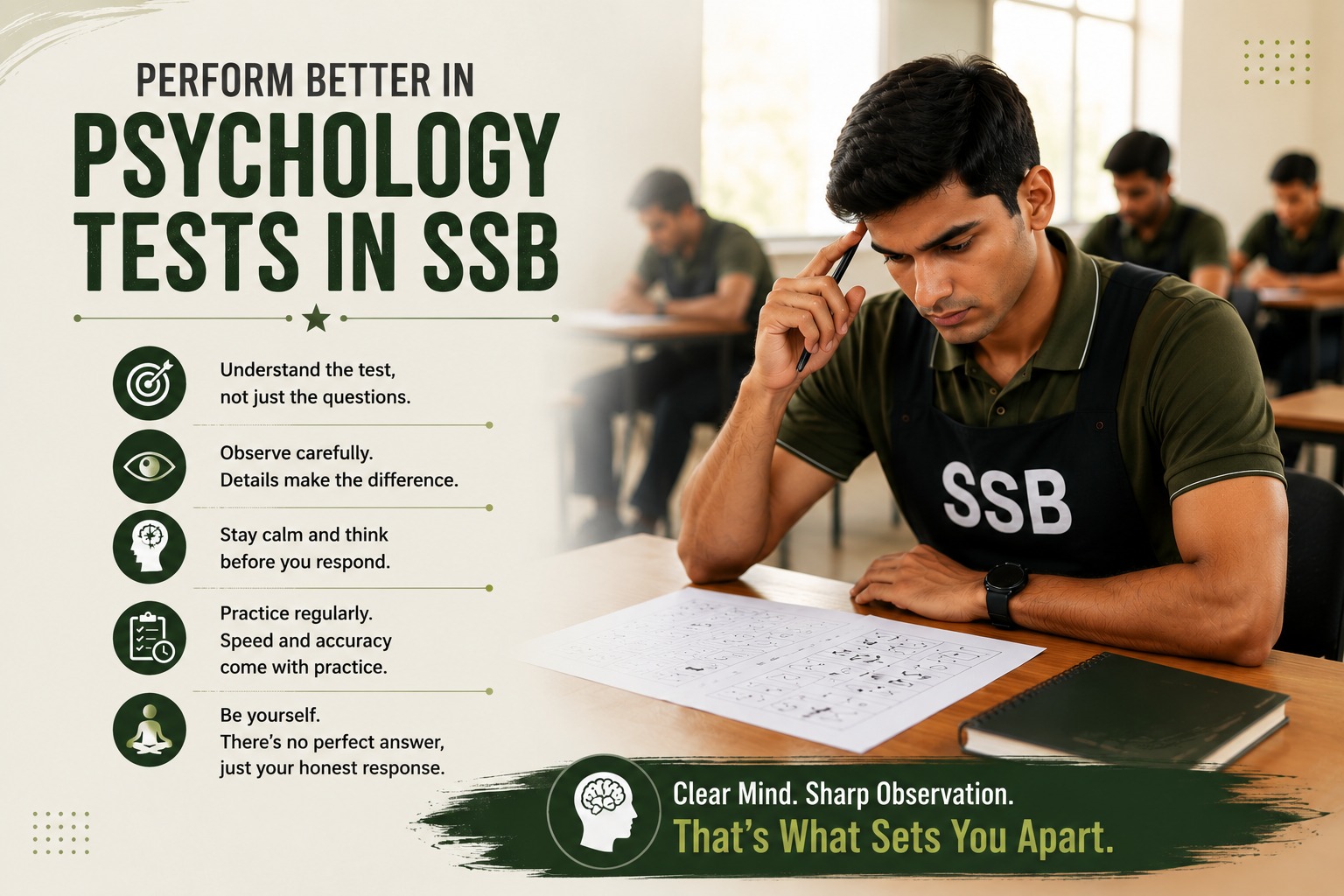
Clear thinking and honest responses are the key to performing well in SSB psychology tests.
Among all stages of the SSB process, the Psychology Tests are probably the most misunderstood. Many candidates enter the testing hall believing that Psychology is about writing “positive” stories, forcing optimistic words into every sentence, or memorising ideal responses from coaching notes and online PDFs.
That approach usually creates more problems than improvement.
The Psychology Tests are not designed to identify candidates who can write the most polished or motivational responses. They are designed to understand how a candidate naturally thinks, reacts, perceives situations, handles pressure, and approaches responsibility.
From an assessor’s perspective, Psychology is less about “right answers” and more about behavioural patterns.
This is why candidates who focus excessively on “smart responses” often become inconsistent, while candidates with natural clarity of thought frequently perform much better.
The psychological assessment process in SSB generally includes:
Each test examines different aspects of personality.
Collectively, they help the psychologist understand:
The psychologist is not searching for “perfect personalities.”
The psychologist is trying to determine whether the candidate demonstrates trainable officer potential through natural behavioural tendencies.
The most common mistake is trying to artificially sound “officer like.”
Candidates often:
This creates unnatural patterns.
For example:
Real human thinking does not work like that.
Experienced psychologists can usually identify exaggerated behavioural projection very quickly.
Natural thinking always contains balance, practicality, emotional realism, and situational variation.
One dangerous myth among candidates is:
“Always write positive.”
This advice becomes harmful when misunderstood.
The expectation is not blind positivity.
The expectation is constructive and practical thinking.
For example:
Candidates should not attempt to become fictional heroes inside psychology tests.
The psychologist is assessing personality maturity, not screenplay writing ability.
In TAT, candidates are shown pictures and asked to write stories within limited time.
The biggest mistake here is forcing prepared templates into every image.
A strong TAT story usually contains:
The central character should behave realistically according to the situation.
The story should reflect:
without becoming exaggerated.
Candidates should avoid:
Simple, believable, organised stories generally create stronger psychological consistency.
WAT is often where candidates panic the most because of speed pressure.
The purpose of WAT is not vocabulary testing.
The psychologist observes spontaneous thought association patterns.
Candidates who memorise responses usually struggle because:
A better approach is:
Candidates often:
For example:
Word: Failure
Weak response:
“Failure is the stepping stone to success.”
This sounds memorised and generic.
More natural response:
“Failure helps identify weaknesses.”
The second response reflects practical thinking more naturally.
SRT evaluates decision making under pressure.
The biggest mistake candidates make is attempting impossible actions in unrealistic timelines.
Psychologists are not impressed by:
Instead, they observe:
Good SRT responses are usually:
For example, if a situation involves an accident, the expectation is not cinematic heroism.
The psychologist is more interested in whether the candidate:
The Self Description test is often neglected during preparation.
But it provides important insight into:
Candidates should avoid:
Strong self descriptions usually reflect:
A candidate who acknowledges weaknesses realistically often appears more psychologically mature than someone projecting perfection.
Psychology improvement does not happen through memorisation.
It improves through personality organisation.
Observe real situations, people, and reactions around you.
Candidates with better observation ability naturally write more practical and realistic responses.
Avoid extreme thinking patterns:
Balanced thinking improves psychological consistency automatically.
Candidates who genuinely handle responsibilities in daily life usually perform better psychologically because their responses emerge from actual behavioural experience.
This may include:
Real life exposure strengthens psychological maturity far more effectively than memorised content.
Candidates who panic under pressure often struggle psychologically because anxiety disrupts natural thinking flow.
Regular practice under timed conditions helps improve composure.
Yes, but correctly.
Practice should focus on:
not memorisation.
Over practice with copied material often damages originality and spontaneity.
The objective is not:
“How do I write perfect responses?”
The objective is:
“How do I think more clearly, practically, and consistently?”
That difference changes preparation quality completely.
From an assessor’s perspective, psychologically strong candidates generally appear:
Not artificially motivational.
Not mechanically positive.
Not unrealistically heroic.
The strongest responses are often the simplest and most believable ones.
The Psychology Tests are difficult because they evaluate spontaneous personality patterns under time pressure.
Candidates who focus only on “what to write” usually struggle more than candidates who focus on “how they naturally think.”
Psychology performance improves gradually through:
At SSBwithISV, psychology preparation focuses less on memorised responses and more on helping candidates understand their natural behavioural patterns, inconsistencies, and thought processes. The long term goal is to develop genuine clarity, practicality, and personality stability that can reflect naturally throughout the psychological assessment process.
KISS rule - Keep It Simple Stupid everywhere in your life
— Lt. Cdr. Nikhil Kumar Chandrakala (Retd.)