
Blog Details
Detailed view of the selected blog post.

Detailed view of the selected blog post.
The Lecturette in SSB is not about speaking perfect English or memorising speeches. It is about expressing your thoughts with clarity, confidence, and structure under pressure. With regular practice, awareness of current topics, and the right approach, anyone can improve in this test. Read the full blog to understand how to prepare effectively for the Lecturette.
Time: 06 min
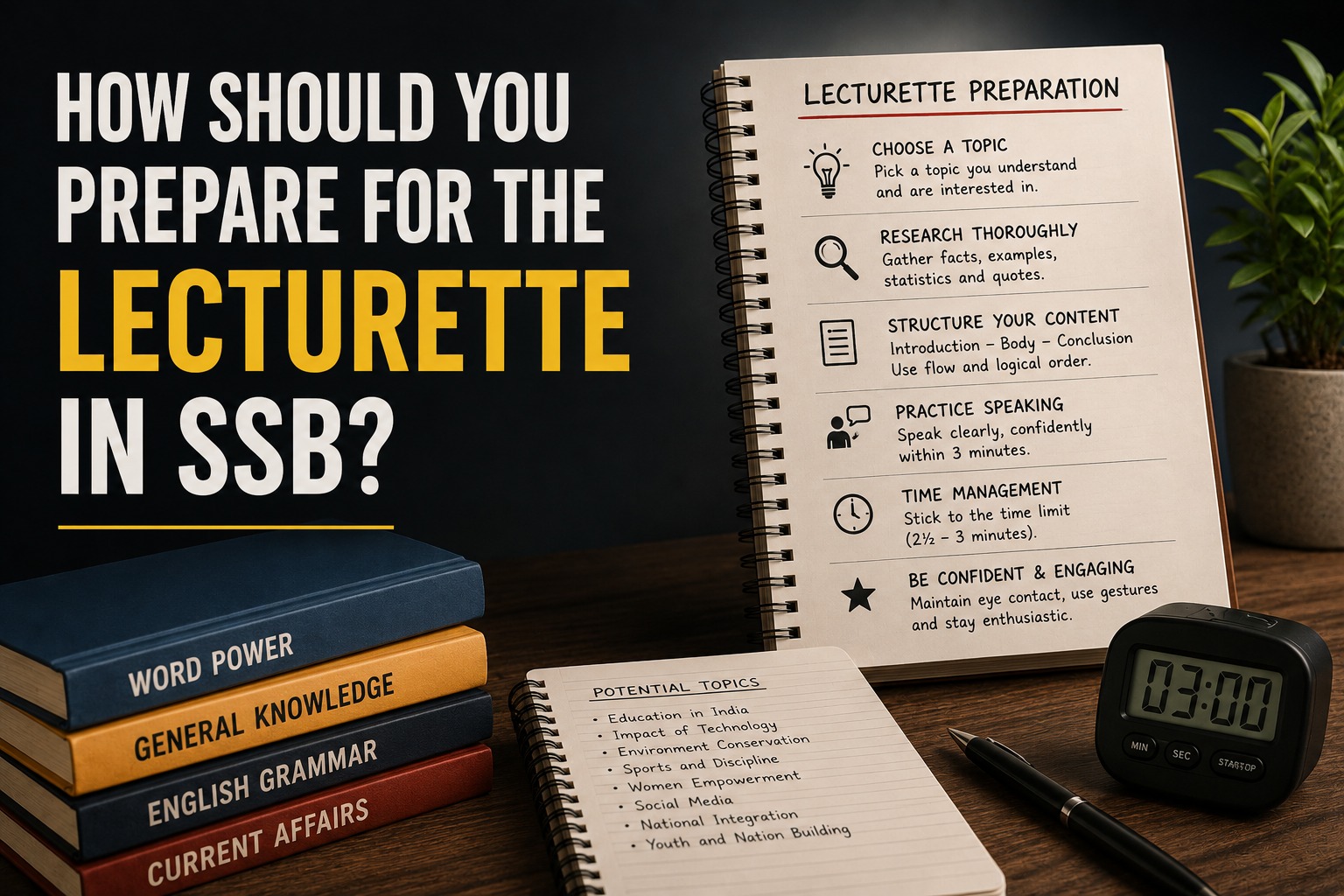
Clarity and confidence win the Lecturette.
Among all GTO tasks in SSB, the Lecturette is one of the most misunderstood activities. Many candidates treat it as a public speaking competition. Some think fluency in English is the deciding factor. Others attempt to impress the Group Testing Officer with heavy vocabulary, complicated statistics, or over rehearsed speeches.
In reality, the Lecturette is not designed to identify professional speakers.
It is designed to evaluate clarity of thought, confidence under observation, organisation of ideas, awareness level, and the ability to communicate effectively in a structured manner.
A candidate is not expected to sound like a news anchor, politician, or motivational speaker. The expectation is much simpler and much more practical. The GTO wants to see whether the candidate can think clearly, organise thoughts logically, and communicate in a balanced and composed manner in front of a group.
This is why candidates with average English but clear thinking often perform better than candidates with polished language but poor structure.
In the Lecturette task, candidates are usually given a card containing four topics arranged according to difficulty level.
The candidate is expected to:
The preparation time is generally around 3 minutes, while the speaking duration is usually around 3 minutes as well, though slight variations may occur across boards.
The task is intentionally short because the assessors are observing spontaneous organisation of thought rather than memorised speeches.
Many candidates focus excessively on content alone. Content matters, but it is not the only factor being observed.
The GTO usually evaluates:
The Lecturette also gives insight into the candidate’s personality maturity. Candidates who become emotionally aggressive, extremely rigid, or completely directionless during expression often reveal behavioural patterns unintentionally.
The most common mistake in Lecturette preparation is memorisation.
Candidates prepare fixed introductions, quotations, statistics, or fancy vocabulary believing that it will create a strong impression.
Unfortunately, over preparation often creates robotic delivery.
The GTO can usually identify when a candidate is speaking naturally versus when the candidate is trying to “perform.”
Another major mistake is trying to sound overly intellectual on topics the candidate does not genuinely understand.
A simple, structured, practical speech creates a far better impression than a highly complicated speech delivered without clarity.
One of the simplest ways to improve Lecturette performance is to follow a clear structure.
Most effective Lecturettes naturally move through three stages:
Start by defining or introducing the topic simply and clearly.
Avoid dramatic openings or artificial quotations unless they fit naturally.
The introduction should immediately establish:
A confused beginning usually affects the entire flow of the speech.
This is where candidates should organise 2 to 4 meaningful points logically.
Depending on the topic, the body may include:
The key is organisation.
Random thoughts without structure make the speech difficult to follow.
The conclusion should summarise the discussion calmly.
Good conclusions usually:
Candidates should avoid abruptly stopping or stretching the speech unnecessarily.
This is one of the most common concerns among candidates.
The answer is straightforward.
Fluency helps, but perfect English is not mandatory.
The GTO is not assessing literary quality. The assessors are evaluating whether the candidate can communicate ideas effectively and confidently.
Candidates who speak simple English with clarity and confidence usually perform much better than candidates who use difficult vocabulary incorrectly.
Excessive focus on accent, grammar perfection, or “fancy English” often increases nervousness unnecessarily.
The priority should always be:
Preparation for Lecturette should focus on improving thinking ability rather than memorising speeches.
Lecturette topics are often linked to:
Candidates do not need expert level knowledge.
However, basic awareness and balanced understanding are extremely important.
Reading newspapers regularly, especially editorial columns, following credible discussions, and developing opinion formation habits help significantly.
Many candidates either finish too early or run out of time.
Regular timed practice helps develop pacing control.
A good approach is:
This gradually improves spontaneous structuring ability.
Candidates who think in scattered sentences often struggle during delivery.
Instead of memorising paragraphs, train yourself to think in:
This improves organisation naturally.
One of the best preparation methods is self observation.
Recording your own Lecturette practice helps identify:
Most candidates improve significantly once they begin observing themselves objectively.
Almost every candidate experiences nervousness during Lecturette.
Even confident candidates feel pressure because they are speaking individually before the group and GTO.
The objective is not to eliminate nervousness completely.
The objective is to function effectively despite nervousness.
The best ways to control nervousness are:
Candidates who try to “sound impressive” usually become more anxious.
Candidates who focus on expressing ideas clearly usually settle faster.
Lecturette topics can range from very simple to moderately analytical.
Examples may include but not limited to:
Candidates are not expected to provide expert analysis.
The expectation is balanced, practical, and organised thinking.
From an assessor’s perspective, a strong Lecturette is usually:
Not theatrical.
Not overly aggressive.
Not artificially intellectual.
Candidates who communicate maturely and organise their thoughts logically generally create stronger impressions than candidates attempting dramatic delivery.
The Lecturette task is less about public speaking talent and more about personality organisation under observation.
It reveals how candidates:
The good part is that Lecturette is one of the most improvable tasks in SSB if approached correctly.
Regular reading, structured thinking, timed speaking practice, and genuine opinion building gradually improve performance far more effectively than memorised speeches.
At SSBwithISV, Lecturette preparation is approached as a personality communication exercise rather than a speaking performance. The focus remains on helping candidates develop clarity of thought, practical awareness, and structured expression, which are the qualities assessors naturally look for during the task.
KISS rule - Keep It Simple Stupid
— Lt. Cdr. Nikhil Kumar Chandrakala (Retd.)