
Blog Details
Detailed view of the selected blog post.

Detailed view of the selected blog post.
Space and AI get all the headlines, but the next geopolitical and economic superpower might not be decided in the stars, it could be decided at the bottom of the sea. Despite covering over 70% of the planet, the deep ocean remains our last unexplored frontier. Now, India is diving headfirst into this unknown with its ambitious Deep Ocean Mission. This isn't just a routine scientific expedition; it is a high-stakes, long-term strategy that could completely reshape resource security, economic power, and global maritime dominance. Want to know how exploring the darkest depths of the ocean will safeguard India’s future and redefine what it means to be a global power? Read on.
Time: 06 min
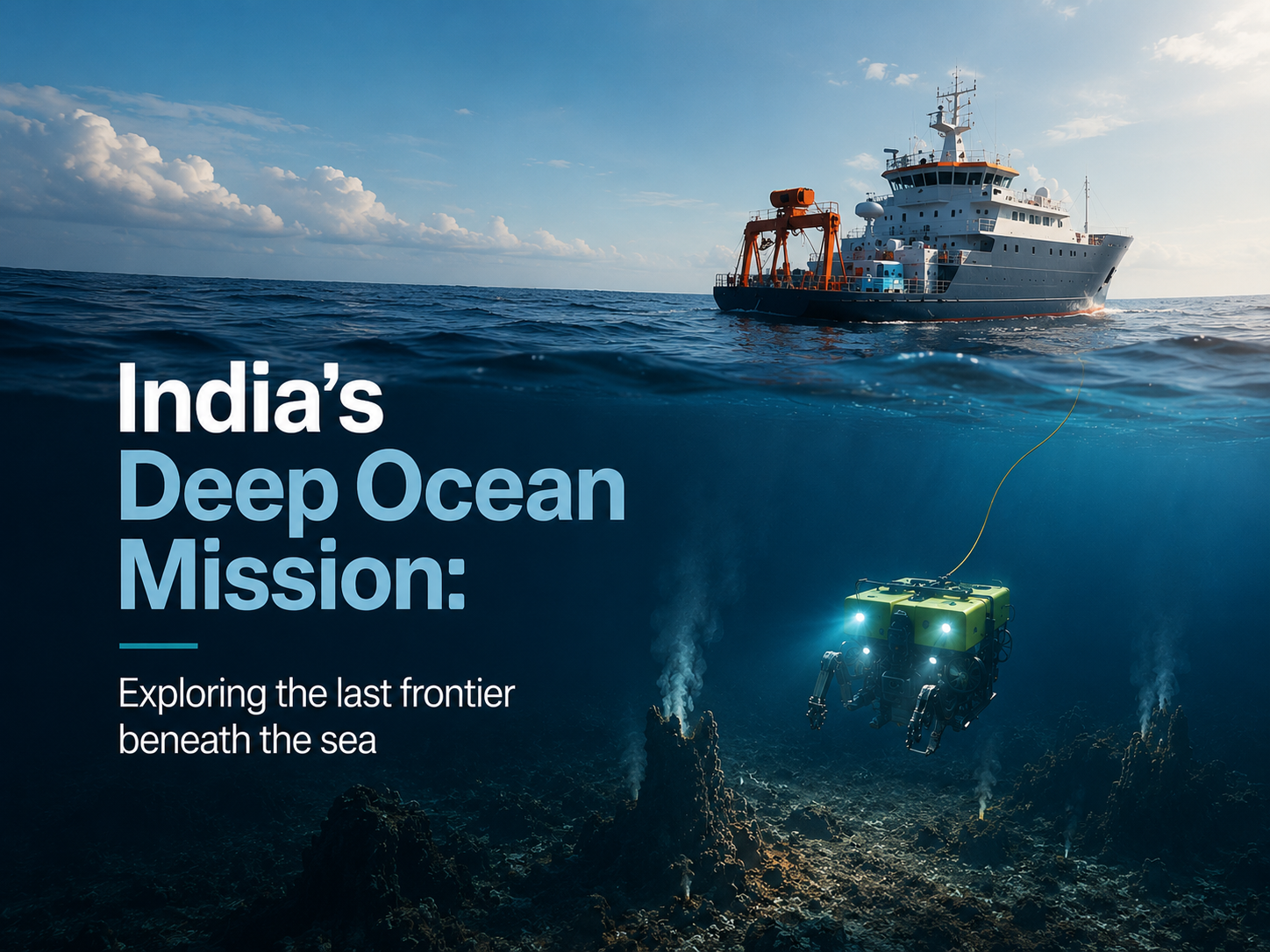
India's Deep Ocean Mission
When people think about strategic resources, technological innovation, or national development, they often look towards space, artificial intelligence, or advanced manufacturing. Very few people think about the vast world that exists beneath the oceans.
Yet, more than 70 percent of the Earth's surface is covered by oceans, and a significant portion of it remains unexplored. In many ways, the deep ocean is one of the last frontiers of scientific discovery.
Recognising its importance, India launched the Deep Ocean Mission, a long term initiative aimed at exploring and understanding the resources, biodiversity, and strategic potential of the deep sea. While the mission is rooted in science and technology, its implications extend far beyond research laboratories. It touches upon economic development, resource security, maritime strategy, and India's future role as a major maritime power.
The Deep Ocean Mission is a flagship initiative of the Ministry of Earth Sciences designed to enhance India's capabilities in deep sea exploration and technology.
The mission focuses on multiple areas, including:
One of its most ambitious goals is the development of a manned submersible capable of carrying scientists to depths of around 6,000 metres below sea level.
Such capabilities are currently possessed by only a handful of countries, making the mission an important step in strengthening India's scientific and technological capabilities.
For centuries, oceans were primarily viewed as routes for trade and transportation. Today, attention is increasingly shifting towards what lies beneath them.
The seabed contains valuable resources that are becoming increasingly important for modern economies. These include minerals such as:
These minerals are critical for manufacturing:
As the global demand for clean energy and advanced technologies grows, competition for access to these resources is also increasing.
Countries are therefore investing heavily in deep sea exploration to understand and potentially utilise these resources in the future.
At first glance, deep sea exploration may appear purely scientific.
However, oceans have always played a major role in national security.
Modern maritime power is not limited to naval ships and ports. It also includes:
Many critical undersea communication cables that support global internet connectivity pass through the ocean floor. Similarly, underwater infrastructure is becoming increasingly important for economic and strategic activities.
Understanding the seabed therefore contributes not only to scientific knowledge but also to maritime awareness and long term strategic planning.
For a country like India, which is heavily dependent on maritime trade and has a vast coastline, strengthening ocean capabilities has clear strategic benefits.
India's geographical position gives it a natural advantage in the Indian Ocean Region.
The Indian Ocean carries a large share of global trade and energy shipments. It is also becoming an increasingly important region in global geopolitics.
As countries seek greater influence in the Indo-Pacific, maritime awareness and ocean based capabilities are becoming more important.
The Deep Ocean Mission supports India's broader maritime objectives by improving scientific understanding of the ocean environment and strengthening technological capabilities related to the marine domain.
This is one reason why the mission is often viewed not only as a scientific project but also as part of India's long term strategic vision.
One of the most important aspects of the Deep Ocean Mission is the focus on indigenous technology development.
Deep sea exploration requires highly specialised equipment capable of operating under extreme pressure and challenging conditions.
Developing technologies such as:
helps reduce dependence on foreign technologies while strengthening domestic scientific capabilities.
This aligns with India's broader objective of building technological self reliance in critical sectors.
The knowledge and technologies developed through the mission may also have applications beyond ocean exploration, contributing to innovation in multiple fields.
While discussions often focus on resources and technology, environmental considerations are equally important.
The deep ocean remains one of the least understood ecosystems on Earth. Scientists are still studying its biodiversity, ecological relationships, and long term environmental significance.
This creates an important challenge.
How can countries utilise ocean resources while ensuring environmental sustainability?
Deep sea ecosystems recover slowly, and any large scale activity requires careful assessment and monitoring. As a result, discussions around deep sea mining and exploration increasingly include questions related to environmental protection and responsible resource management.
The future of ocean exploration will likely depend on finding a balance between economic opportunities and ecological preservation.
Many national projects focus on solving immediate challenges. The Deep Ocean Mission is different because it is fundamentally focused on preparing for future opportunities.
The mission aims to develop capabilities that may become increasingly valuable over the coming decades as:
Investments in deep ocean research today may influence scientific, economic, and strategic outcomes many years into the future.
This long term perspective is one reason why the mission has attracted significant attention from policymakers and researchers alike.
Humanity has explored parts of outer space more extensively than some regions of the deep ocean. Despite covering most of the planet, the oceans remain among the least understood environments on Earth.
India's Deep Ocean Mission represents an effort to change that reality.
It is not simply a scientific expedition beneath the sea. It is an investment in knowledge, technology, resource security, and future readiness. As competition for critical resources and technological leadership continues to increase globally, understanding the oceans may become just as important as understanding space.
The mission also reflects a broader shift in strategic thinking. Nations today are not only looking towards the skies for future opportunities; they are increasingly looking beneath the waves as well.
At SSBwithISV, topics such as the Deep Ocean Mission are valuable because they encourage candidates to connect science, technology, economics, environment, and national security together. Developing this broader perspective helps build the analytical thinking and awareness expected from future leaders in an increasingly complex world.
KISS rule - Keep It Simple Stupid
— Lt. Cdr. Nikhil Kumar Chandrakala (Retd.)