
Blog Details
Detailed view of the selected blog post.

Detailed view of the selected blog post.
India's rise as a global space power is more than a story of rockets and missions. It reflects decades of scientific vision, strategic planning, and technological self-reliance. Discover how India's space journey is shaping its future on Earth and beyond, and why every defense aspirant should understand its growing significance.
Time: 07 min
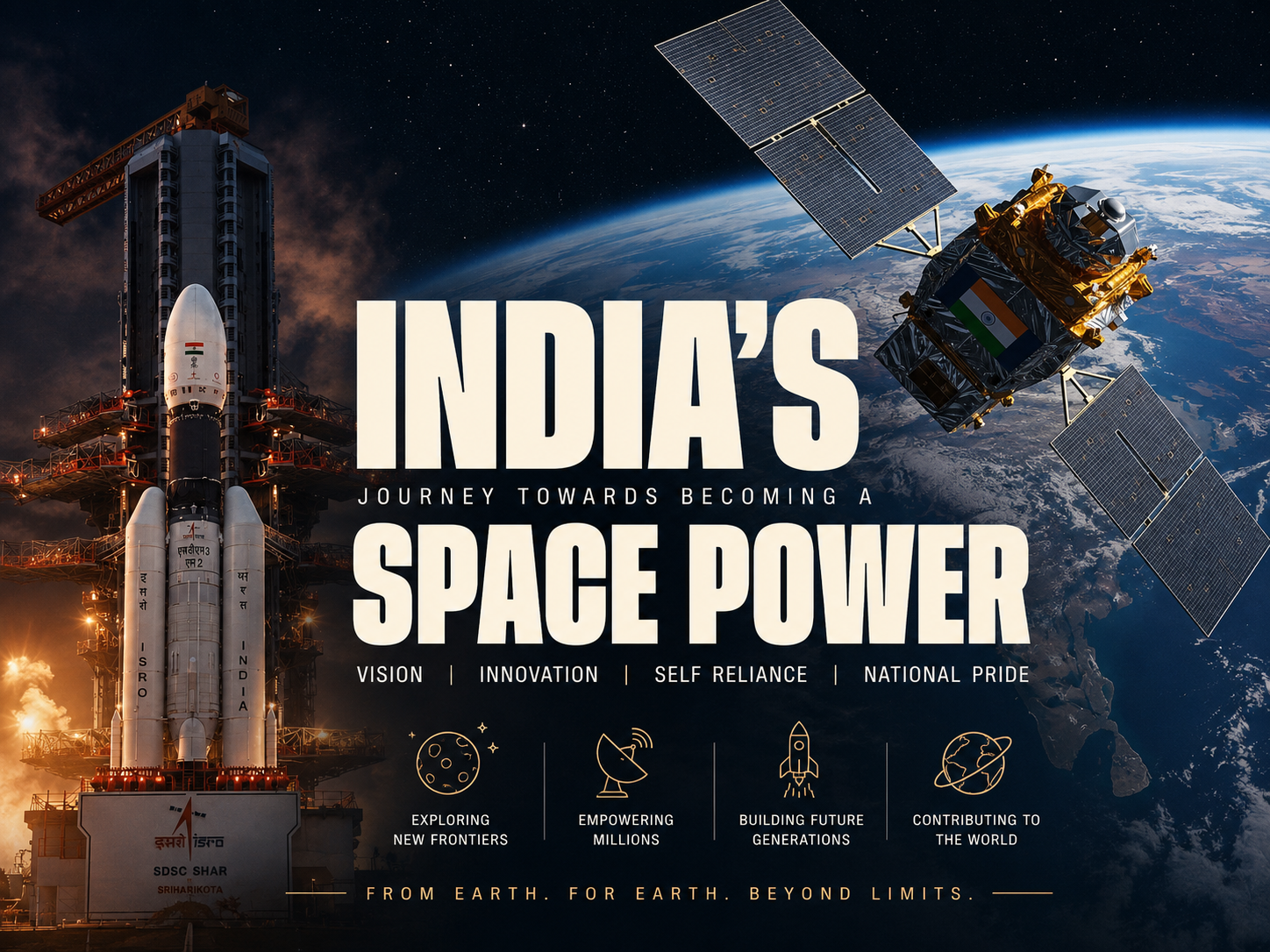
India's journey towards becoming a space power
For much of the twentieth century, space exploration was dominated by a handful of major powers. The United States and the Soviet Union led the early space race, while only a few countries possessed the technology, resources, and expertise required to conduct advanced space missions.
Today, the global space landscape is changing rapidly.
India has emerged as one of the world's most respected spacefaring nations, achieving remarkable milestones through innovation, cost efficiency, and scientific capability. From launching satellites for multiple countries to successfully landing near the Moon's south pole, India's space programme has evolved from a developmental initiative into a symbol of national capability and technological confidence.
The country's journey towards becoming a major space power is not only a story of scientific achievement but also one of strategic vision, self reliance, and long term national ambition.
India's space journey started with a clear developmental focus.
The early vision of the Indian space programme was not centred on prestige or competition. Instead, it focused on using space technology to support national development through:
Over the decades, organisations such as the Indian Space Research Organisation (ISRO) developed indigenous capabilities in satellite technology, launch vehicles, remote sensing, and navigation systems.
What makes India's progress particularly noteworthy is that it was achieved despite limited resources compared to many other major space powers.
Through consistent investment, scientific talent, and long term planning, India gradually built a strong foundation for future achievements.
One of the most important milestones in India's space journey has been the Chandrayaan programme.
Chandrayaan missions significantly enhanced India's reputation within the global scientific community and demonstrated the country's growing technological capabilities.
The success of Chandrayaan 3 attracted worldwide attention because India became the first country to achieve a successful landing near the lunar south pole. This region is of particular scientific interest because of its potential water ice deposits and its importance for future lunar exploration.
The mission showcased India's ability to execute complex space operations while maintaining a highly cost effective approach.
More importantly, it demonstrated that India was no longer merely participating in space exploration but actively contributing to global scientific understanding.
While lunar missions captured public attention, India also expanded its ambitions beyond the Moon.
The Aditya L1 mission marked India's first dedicated solar observation mission. Positioned near the Lagrange Point 1, the spacecraft is designed to study the Sun and various solar phenomena.
Understanding solar activity is important because solar events can affect:
The mission reflects the growing maturity of India's space programme.
Instead of focusing solely on demonstration missions, India is increasingly contributing to advanced scientific research with global relevance.
Perhaps one of the most anticipated developments in India's space programme is the Gaganyaan mission.
The project aims to send Indian astronauts into space using an indigenous human spaceflight system.
Human spaceflight represents one of the most complex challenges in space exploration. Unlike satellite launches, it requires extremely high standards of reliability, safety, life support systems, crew training, and mission planning.
A successful Gaganyaan mission would place India among a select group of nations that have independently developed human spaceflight capabilities.
Beyond its technological significance, the programme is expected to generate advancements across multiple sectors including:
The mission therefore represents both a scientific achievement and an investment in national technological capability.
Space is no longer viewed only as an area for scientific exploration.
Today, it has become an important component of national security, economic development, and strategic competition.
Modern societies depend heavily on space based infrastructure for:
Military forces around the world increasingly rely on satellites for surveillance, intelligence gathering, navigation, and communication.
As a result, countries are investing heavily in strengthening their space capabilities.
For India, maintaining a strong presence in space supports both developmental and strategic objectives. It enhances technological independence while reducing dependence on external systems.
One of the most significant recent developments is the emergence of India's private space ecosystem.
For many years, space activities in India were largely led by government institutions. Today, private companies are increasingly participating in:
Policy reforms and institutional support have created opportunities for startups and private enterprises to contribute to the country's growing space economy.
This shift is important because the future growth of the global space sector is expected to be driven not only by governments but also by commercial innovation.
A vibrant private space industry can accelerate technological development, generate employment, and strengthen India's position within the global space market.
Many people associate space programmes only with rockets and astronauts.
In reality, space technology influences daily life in numerous ways.
Satellite systems support:
The benefits of space exploration often extend far beyond the missions themselves.
Technologies developed for space applications frequently find use in civilian industries, healthcare, transportation, and manufacturing.
This is one reason why investments in space programmes are often viewed as investments in broader technological progress.
India's achievements in space are often celebrated as milestones of national pride. While that recognition is deserved, the deeper significance lies elsewhere.
The space programme demonstrates what long term vision, scientific investment, and institutional continuity can achieve over time.
From launching small satellites to planning human spaceflight missions, India has steadily expanded its capabilities without abandoning its original focus on national development.
The journey also highlights an important lesson: technological progress is rarely achieved through short term efforts. It requires patience, sustained investment, skilled human resources, and a willingness to pursue ambitious goals over decades.
As the global space sector continues to evolve, India's role is likely to become even more significant. Future missions may explore new scientific frontiers, strengthen strategic capabilities, and create opportunities that are difficult to fully imagine today.
At SSBwithISV, discussions on developments such as Chandrayaan, Aditya L1, Gaganyaan, and India's growing space ecosystem are approached not simply as current affairs topics, but as examples of how vision, innovation, and long term planning shape national progress. Understanding such developments helps aspirants build informed perspectives on science, technology, and India's evolving role in the world.
KISS rule - Keep It Simple Stupid
— Lt. Cdr. Nikhil Kumar Chandrakala (Retd.)