Blog Details
Detailed view of the selected blog post.

Detailed view of the selected blog post.
This blog demystifies TAT, WAT, SRT, and Self-Description by explaining what SSB psychologists truly assess. It highlights common writing errors, artificial responses, and how self-awareness leads to consistency across the SSB process.
Time: 07 min
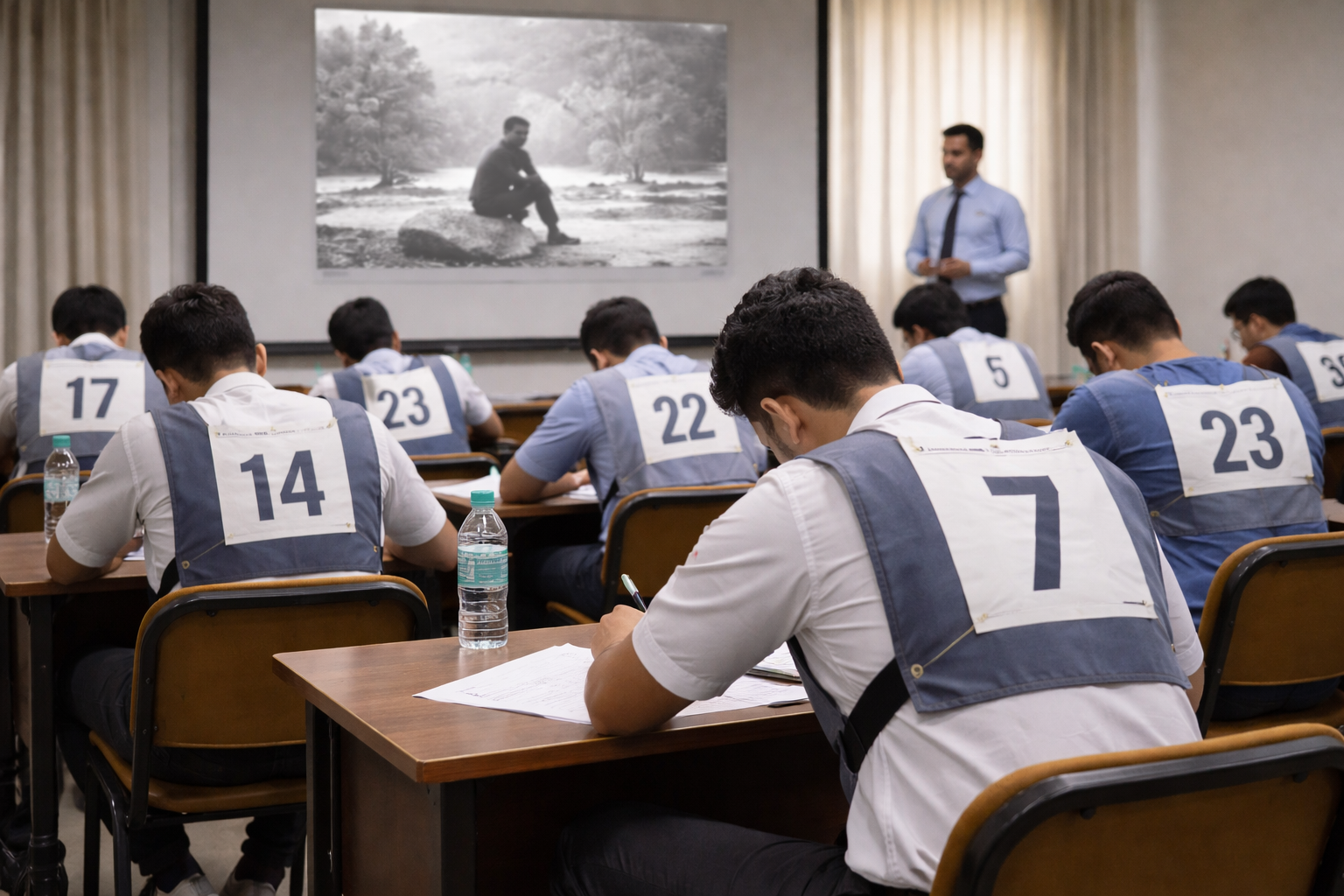
An AI generated image imitating Psych Tests at SSBs/ AFSBs
Psychology tests are where most aspirants unknowingly eliminate themselves—not because they write poorly, but because they write unnaturally.
SSB psychology tests are not creativity tests. They are personality mapping tools designed to reveal how a candidate thinks, feels, reacts, and recovers. The candidates are expected to write the responses through their “sub-conscious”. Human mind's sub-conscious is comprised of memories and stored knowledge.
Across TAT, WAT, SRT, and Self-Description, psychologists assess:
They are not judging optimism. They are judging authenticity and stability.
This is false.
Artificial positivity is one of the easiest patterns for psychologists to detect. Over-heroic characters, unrealistic outcomes, and exaggerated moral victories signal social desirability bias—a red flag.
Remember pictures are stimulus. Pictures are not negative and therefore stories cannot be negative. The thought process can definitely be negative.
Negative situations are not penalised. What matters is:
In TAT, psychologists observe:
Stories that jump straight to success without appropriate actions appear artificial.
WAT responses reveal:
Trying to force “positive” words under time pressure creates inconsistency. Natural associations are more reliable.
SRT is about reaction quality, not speed. Psychologists observe:
Unrealistic actions under extreme stress expose immaturity.
SD is not self-praise. It tests:
Candidates who describe themselves as flawless lose credibility.
Psychology tests do not stand alone. Responses are matched with:
When internal responses match external behaviour, confidence in assessment increases.
The only effective preparation is self-understanding, not sample answers.
Candidates who understand how they genuinely react under pressure automatically write consistent responses. Those who copy templates fail silently.
Karam Wahi Karo Jo Karna Hi Fal Lage, Kyuki Karam Hi Dharam.
— Lt. Cdr. Nikhil Kumar Chandrakala (Retd.)