Blog Details
Detailed view of the selected blog post.

Detailed view of the selected blog post.
If you’ve been following the latest updates from the Directorate General of Recruiting (DG Rtg), you’ll know that the selection centres are undergoing a major digital transformation. The "old school" ways are being swapped for something much sharper and more objective. The Army is moving toward the Computerised Stage-1 Selection System (CSSS). If you’re still trying to "crack" the SSB with memorised stories or rehearsed patterns, you’re going to hit a digital wall. This new system blends mental capability and personality assessment into one integrated process
Time: 06 min
Officer Induction Trend 2015 - 25
In order to make the Stage-1 process more transparent and objective, Computer Based Stage-1 Tests have been planned to be incorporated across Selection Centres. These tests have been developed by DIPR, and the trials for the same were completed at Selection Centre South, Bengaluru between January and March 2025. After completion of data analysis and user trials, the system is expected to be implemented across all Selection Centres by July 2026.
SSB Integration and Management Software (SIMS) is also being developed in coordination with DGIS to bring all Selection Centres onto a common platform. The software will include hosting on the Army Data Network (ADN), thereby integrating all Selection Centres with the Directorate General of Recruiting. The same is planned to be implemented by June 2026.
Various projects for infusion of technology and Artificial Intelligence into the SSB assessment process are also under different stages of inclusion. These include computer based psychological testing, AI assisted personality assessment, document verification systems, and digital support tools for assessors.
The CSSS isn't just a new test; it’s a whole new way of looking at you. It stops treating your intelligence and personality as separate silos. Instead, it looks at the "Total Package" in a single sitting that lasts about 1 to 1.5 hours and covers roughly 190 questions.
Another important possibility being discussed within the evolving CSSS framework is that it may eventually conjoin OIR and PPDT into one integrated Stage-1 assessment system. Instead of treating intelligence testing and perception based evaluation separately, the future model may assess observation, reasoning, comprehension, decision making, and behavioural responses together within one unified computer based environment. This would make the screening process faster, more standardised, and significantly more objective.
Component Total Questions Primary Focus
Cognitive Battery ~70 Mental speed, accuracy, and executive functions.
OPAM (Personality) ~120 Officer-Like Qualities (OLQs) and behavioural consistency.
The first 70 questions are all about your mental efficiency. This isn’t a school exam where you can study facts. It’s testing how your brain actually functions under pressure.
Real-Time Processing: How fast and accurately can you make a call?
Spatial & Memory Skills: Can you recognise visual patterns or navigate route-based problems in seconds?
Clarity Under Pressure: The goal is to see if you have the attention and concentration to survive in dynamic environments.
The Objective Personality Assessment Measure (OPAM) uses 120 self-report questions to map out your 15 Officer-Like Qualities (OLQs).
Consistency is Key: The system checks if your responses match up across multiple questions. You can't "fake" a personality for 120 questions when an algorithm is checking for genuine traits.
Objective Evaluation: Because it’s computerised, it removes human bias. It doesn’t care how well you talk; it only cares if your personality naturally reflects qualities like initiative, courage, and social adaptability.
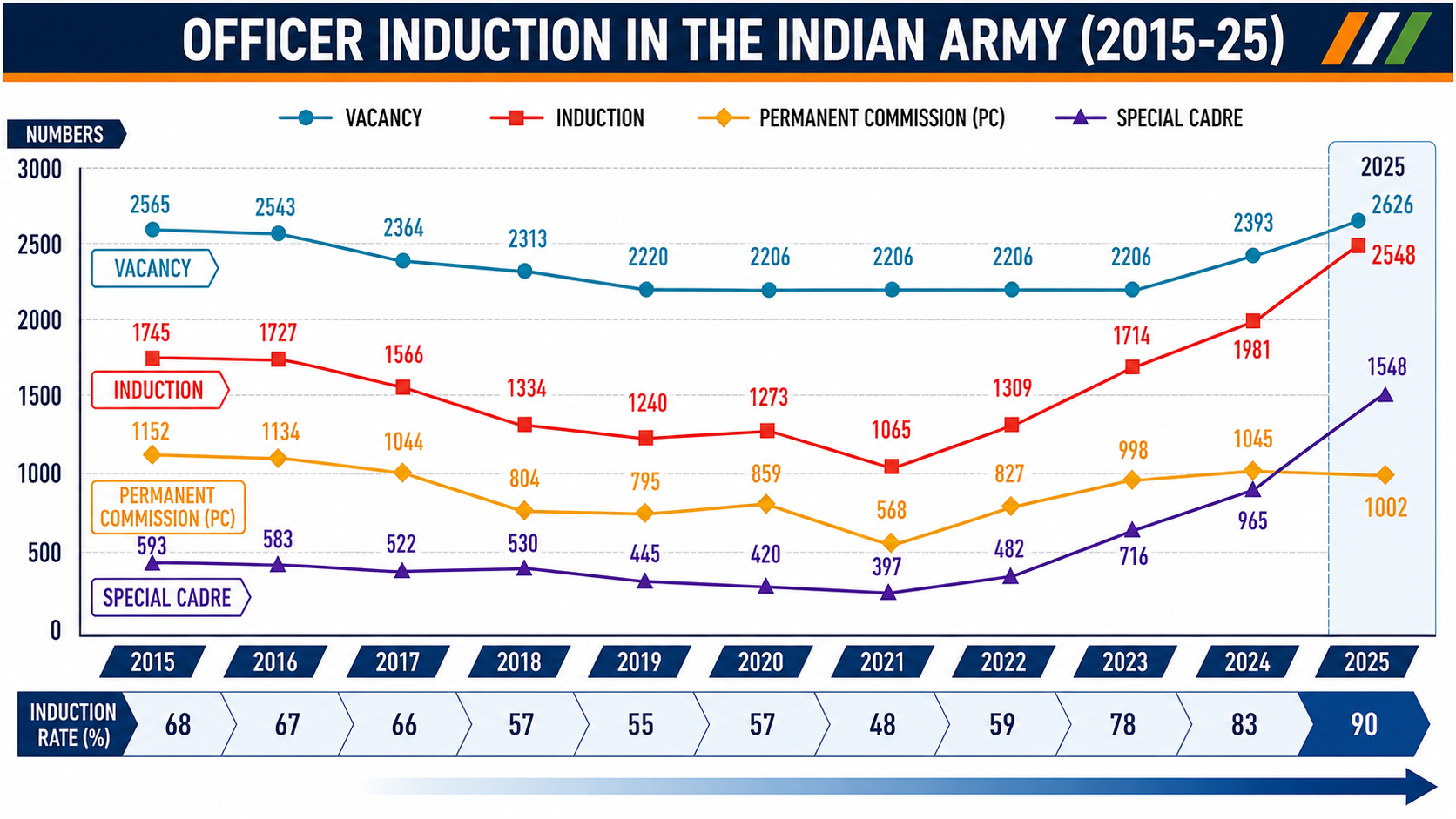
The Army is modernising fast to make the selection process smoother and more transparent. The data from the 2025 cycle shows a record 90% induction rate (2,548 candidates), with Short Service Commission (SSC) entries leading the way for the first time. For the first time, SSC induction has also exceeded Permanent Commission entries, indicating a major shift in future manpower structuring trends.
The latest induction trends from 2015-2025 also show that officer deficiency has reduced from nearly 19 percent in 2015 to around 14 percent in 2024. Current induction patterns indicate that the mitigation trend achieved over the last seven years is beginning to stabilise officer requirements more effectively across the system.
Specialist cadre induction trends further show that SSC entries now dominate the intake structure, significantly exceeding SCO and Permanent Commission entries in several branches. This reflects the Army’s increasing dependence on SSC based manpower balancing.
To keep this momentum, the following changes are rolling out:
Medical Relief: SSB medical results now last for 270 days (9 months), preventing the need for "double meds" between entries.
Candidate Choice: You can now select your own SSB centre and dates of choice.
AI Integration: AI is being introduced for personality assessments and document verification, while the SIMS software will link all centres by June 2026.
Full Rollout: The computerised CSSS will be active at all Selection Centres by July 2026.
One of the biggest advantages of computer based screening is time efficiency. Faster evaluation and automated processing may eventually help save significant testing time, making the overall assessment cycle smoother and more streamlined. This may also allow certain psychological assessments to begin on the same day itself in future testing structures.
As the system becomes more efficient, Selection Centres may also be able to conduct a higher number of batches every year, improving candidate handling capacity and reducing administrative load across centres.
In the long term, the system may evolve in a direction similar to the Indian Coast Guard Stage-1 model, where candidates could appear for computer based screening tests at authorised centres closer to their home locations. Candidates may then only need to travel to SSB centres after clearing the initial screening stage. If implemented in the future, this would reduce travel burden, improve accessibility, and make the selection process far more efficient for candidates across the country.
You cannot "game" a computer that is built to detect consistency. Preparation must shift from memorisation to developing real abilities and clarity of thought.
At SSBwithISV, we’ve been using professional frameworks since July 2021 to help students identify their personality "gaps". To start your own self-analysis, consider exploring tools like the Big Five (OCEAN) model, 16PF, or the Johari Window. These aren't part of the SSB, but they are great for identifying your own blind spots. - test
The system is changing; it’s time for your preparation to change too. Focus on being your most consistent, practical self.
KISS rule - Keep It Simple Stupid
— Lt. Cdr. Nikhil Kumar Chandrakala (Retd.)