
Blog Details
Detailed view of the selected blog post.

Detailed view of the selected blog post.
The Great Nicobar Island Project has emerged as one of the most ambitious infrastructure initiatives planned in independent India. Located at the southernmost tip of the Andaman and Nicobar archipelago, Great Nicobar Island occupies a unique geographical position that gives it significance far beyond its size.
Time: 08 min
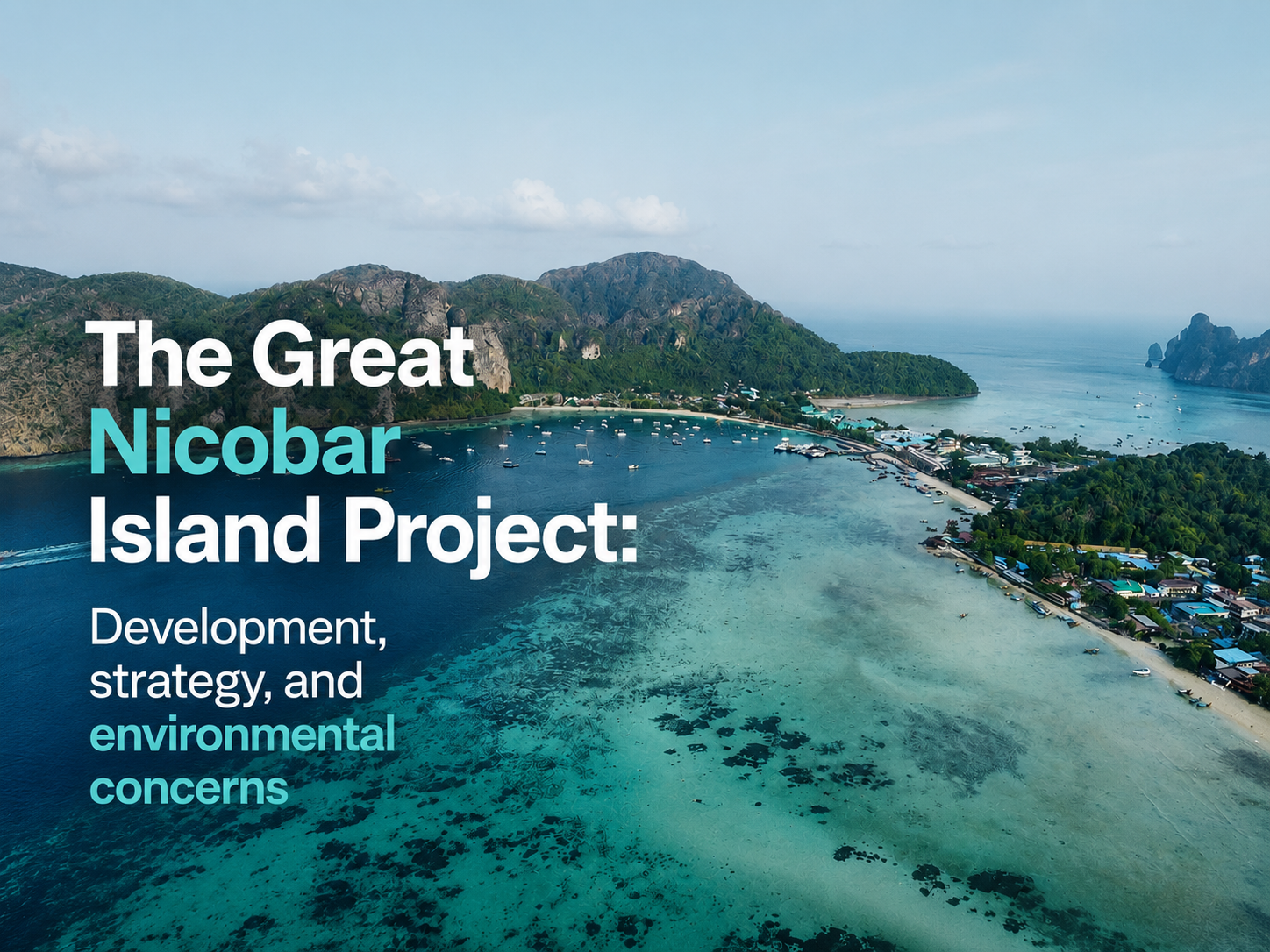
The Great Nicobar Island Project
Supporters view the project as a major step towards strengthening India's maritime presence, improving connectivity, and unlocking economic opportunities in the Indian Ocean Region. Critics, however, raise concerns about its environmental impact and the long term consequences for one of India's most ecologically sensitive regions.
As a result, the Great Nicobar Island Project has become an important topic in discussions related to development, environmental sustainability, national security, and geopolitics.
To understand the significance of the project, it is important to first understand the location of Great Nicobar Island.
The island lies close to the Malacca Strait, one of the busiest maritime trade routes in the world. A significant portion of global trade and energy shipments passes through this region every year. Any country with a strong presence near this strategic chokepoint gains an important advantage in terms of maritime awareness, logistics, and regional influence.
For India, Great Nicobar provides a valuable opportunity to strengthen its presence in the eastern Indian Ocean and the wider Indo-Pacific region. As geopolitical competition continues to increase across the Indo-Pacific, strategic locations such as Great Nicobar are attracting greater attention from policymakers and security planners.
This strategic importance forms one of the strongest arguments in favour of the project.
The proposed development plan aims to transform Great Nicobar into a major economic and strategic hub.
Key components of the project include:
The transshipment port is expected to become one of the most significant parts of the project. Currently, a large share of India's container cargo is handled through foreign ports before reaching its final destination. A major transshipment hub in Great Nicobar could potentially reduce this dependence and improve India's position in global maritime trade.
Supporters argue that such infrastructure development could generate employment, improve regional connectivity, and strengthen India's economic presence in the Indian Ocean.
Large infrastructure projects are often viewed as catalysts for economic growth, and Great Nicobar is no exception.
The project is expected to create opportunities in:
If implemented successfully, the project could help integrate the island more closely with national economic networks while also improving connectivity with Southeast Asian economies.
The location itself provides significant potential because of its proximity to major international shipping routes.
For a country aspiring to become a larger maritime and economic power, such opportunities naturally attract attention.
While the developmental and strategic arguments are substantial, the project has also generated intense debate because of environmental concerns.
Great Nicobar Island is one of India's most ecologically rich regions. It contains dense tropical forests, unique biodiversity, and several species that are found nowhere else in the world.
Environmental groups and researchers have expressed concerns regarding:
The island is home to important wildlife populations, including species that are protected under Indian conservation laws. Any large scale construction activity in such regions naturally raises questions about habitat fragmentation and biodiversity loss.
This has led to a broader debate regarding how development projects should be balanced with environmental protection.
The debate surrounding Great Nicobar is often presented as a conflict between development and conservation.
However, the real challenge is not choosing one over the other.
The challenge is finding a balance that allows economic growth while minimising environmental damage.
India faces this dilemma in many sectors. Infrastructure projects, highways, industrial corridors, renewable energy installations, and urban expansion often require difficult decisions involving environmental trade offs.
The Great Nicobar Project highlights a larger national question:
How can a developing country pursue economic growth and strategic objectives while preserving ecologically sensitive regions?
There are no easy answers.
This is why environmental impact assessments, mitigation measures, sustainable planning, and continuous monitoring become extremely important.
Beyond economics and environmental concerns, the project also carries geopolitical significance.
The Indo-Pacific region has become one of the most strategically important areas in the world. Global powers are increasingly focusing on maritime routes, connectivity networks, logistics infrastructure, and regional partnerships.
For India, strengthening infrastructure in the Andaman and Nicobar Islands supports broader objectives related to:
The location of Great Nicobar gives India an opportunity to enhance its maritime reach while improving awareness of activities in surrounding waters.
This is one reason why the project is often discussed not only in economic circles but also within strategic and defence communities.
The Great Nicobar Island Project represents a modern policy challenge where multiple national priorities intersect.
Economic growth, environmental sustainability, national security, infrastructure development, and geopolitical strategy are all connected to this single project.
This is precisely why the issue generates such diverse opinions.
Some view it primarily as a development project.
Others see it as a strategic necessity.
Many focus on environmental risks.
In reality, all of these perspectives have merit and deserve careful consideration.
Understanding such issues requires moving beyond simplistic arguments and appreciating the complexity of policymaking in a rapidly changing world.
The debate surrounding Great Nicobar is unlikely to be the last of its kind.
As India continues to grow, similar questions will emerge across multiple sectors. The country will need more infrastructure, better connectivity, stronger logistics networks, and greater strategic capabilities. At the same time, environmental sustainability will remain an equally important national priority.
The challenge for policymakers will not be choosing development or conservation.
The challenge will be ensuring that both can progress together in a manner that is responsible, sustainable, and beneficial for future generations.
The Great Nicobar Island Project serves as a reminder that modern nation building often involves balancing competing priorities rather than pursuing simple solutions.
At SSBwithISV, discussions on such topics are encouraged not merely as current affairs preparation, but as opportunities to develop balanced thinking, analytical ability, and informed decision making. Understanding both sides of complex national issues is an important step towards developing the maturity and judgement expected from future leaders.
KISS rule - Keep It Simple Stupid
— Lt. Cdr. Nikhil Kumar Chandrakala (Retd.)