
Blog Details
Detailed view of the selected blog post.

Detailed view of the selected blog post.
The age of relying solely on massive tanks and multi-million dollar fighter jets is officially over. Across modern battlefields, cheap, AI-driven military drones and "kamikaze" loitering munitions are completely rewriting the rules of combat. By stripping away the ability to hide and neutralizing massive military assets at a fraction of the cost, these unmanned systems are forcing global powers-including India, to rapidly overhaul their defense strategies. Want to see how drone swarms and high-tech counter-systems are shifting the global balance of power? Read on to glimpse the hyper-connected battlefield of the future.
Time: 07 min
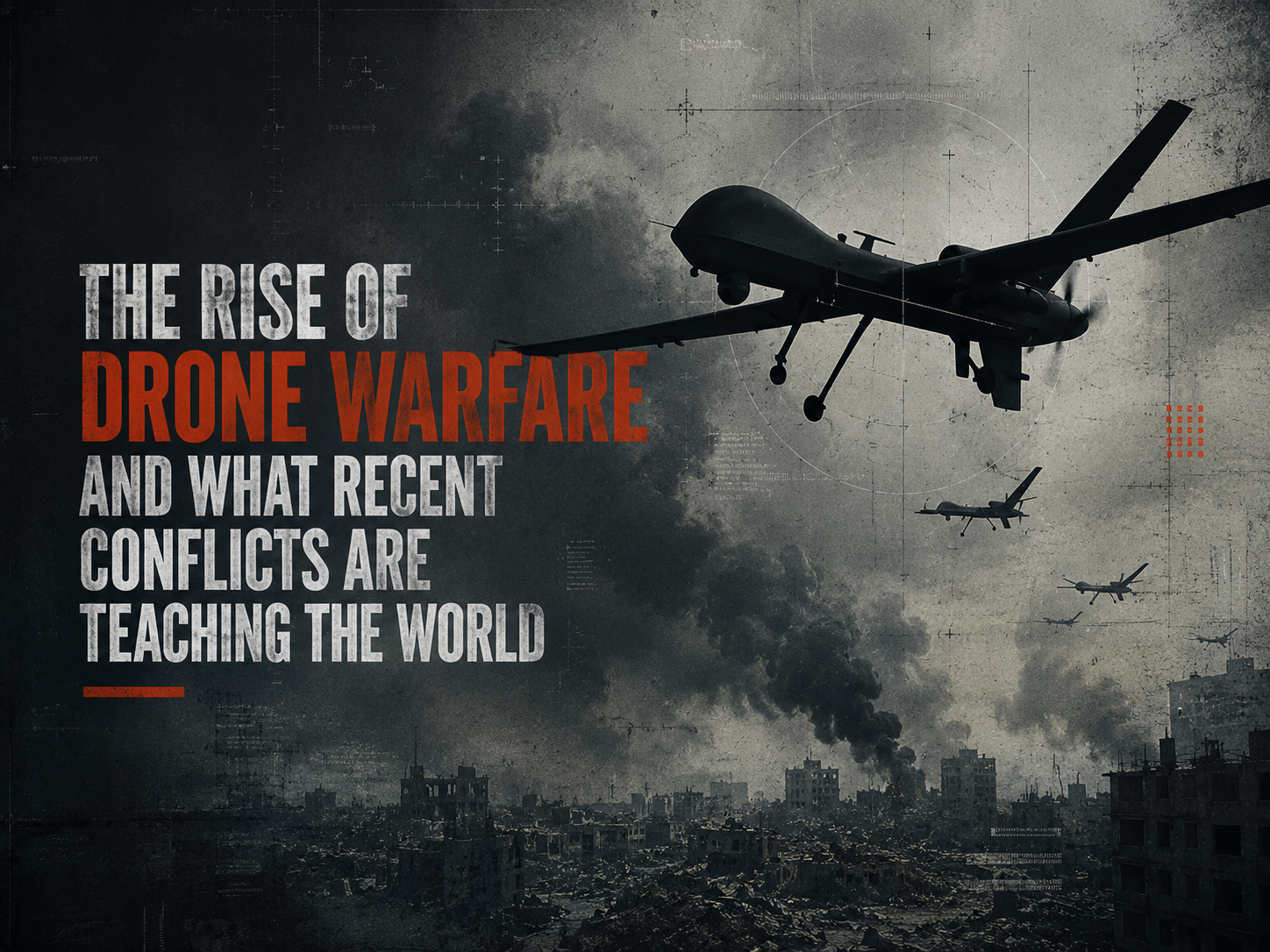
The rise of drone warfare and what recent conflicts are teaching the world
For decades, military power was often measured through tanks, fighter aircraft, warships, and large standing armies. While these platforms continue to remain important, recent conflicts have highlighted another technology that is rapidly changing the nature of warfare: drones.
Once viewed mainly as surveillance tools, drones have evolved into platforms capable of reconnaissance, precision strikes, intelligence gathering, electronic warfare, and even direct combat. From the Middle East to Eastern Europe, drones are increasingly influencing battlefield outcomes and military planning.
The growing importance of drone warfare has forced militaries across the world to rethink traditional concepts of combat, force structure, and defence preparedness.
A military drone, often referred to as an Unmanned Aerial Vehicle (UAV), is an aircraft that can operate without a pilot onboard.
Depending on its purpose, a drone may be used for:
Some drones are controlled remotely by operators, while others possess varying degrees of autonomous capability.
The rapid improvement in sensors, communication systems, artificial intelligence, and battery technology has significantly increased the effectiveness of modern drones.
One of the biggest advantages of drones is their ability to perform missions at a fraction of the cost of many traditional military platforms.
A modern fighter aircraft may cost hundreds of millions of dollars and place pilots at risk. In comparison, many drones are relatively inexpensive and can operate in dangerous environments without risking human lives.
This creates several advantages:
For military planners, drones offer a combination of flexibility, affordability, and effectiveness that is difficult to ignore.
As a result, many countries are investing heavily in drone development and counter-drone systems.
Recent conflicts have demonstrated that drones are no longer supporting assets. In many situations, they have become central to military operations.
The conflict in Ukraine has particularly highlighted the growing role of drones. Both sides have used various types of drones for surveillance, artillery correction, intelligence gathering, and precision attacks.
Commercial drones modified for military use have also appeared on the battlefield, demonstrating how accessible technology can be adapted for combat purposes.
One of the most important lessons from these conflicts is that battlefield visibility has changed dramatically.
In earlier wars, locating enemy positions often required significant reconnaissance efforts. Today, drones can provide near real time information, making concealment much more difficult.
The side that sees first often gains a major operational advantage.
Another significant development is the emergence of loitering munitions, sometimes referred to as "kamikaze drones."
These systems combine the characteristics of drones and missiles.
Instead of immediately striking a target, they can remain airborne for extended periods while searching for suitable targets. Once identified, they can engage with high precision.
This capability allows military forces to attack high value targets while reducing the need for expensive missile systems.
Recent conflicts have shown that loitering munitions can be highly effective against:
Their growing use suggests that future battlefields may witness increased integration of such systems.
The rise of drone warfare does not mean traditional military platforms have become obsolete.
Tanks, aircraft, artillery, naval forces, and infantry remain essential components of military power.
However, recent conflicts demonstrate that these assets must increasingly operate alongside unmanned systems.
Military planners are now focusing on:
Modern warfare is becoming more connected, data driven, and technology intensive.
The challenge for armed forces is not replacing traditional systems but integrating new technologies effectively.
As drones become more capable, protecting against them becomes equally important.
Recent conflicts have demonstrated that even relatively inexpensive drones can threaten expensive military equipment.
This has led to growing investment in:
The contest between drones and counter-drone systems is rapidly becoming one of the most important aspects of modern military innovation.
In many ways, future conflicts may involve a continuous competition between unmanned platforms and the technologies designed to neutralise them.
India has also recognised the strategic importance of drone technology.
In recent years, the country has taken multiple steps to strengthen its domestic drone ecosystem through policy reforms, innovation initiatives, and indigenous development programmes.
The applications of drones extend beyond defence and include:
This dual use nature makes drone technology an important area for both economic development and national security.
As India's defence modernisation continues, drones are expected to play an increasingly important role across military operations and border management.
The rise of drones reflects a larger trend in military affairs.
Technology is increasingly shaping how wars are fought, how intelligence is gathered, and how decisions are made on the battlefield.
Future conflicts may involve:
The military organisations that adapt quickly to these changes are likely to gain significant advantages.
At the same time, technological superiority alone does not guarantee success. Training, leadership, strategy, adaptability, and sound decision making remain just as important as advanced equipment.
The rise of drone warfare is not simply a story about new machines. It represents a shift in military thinking itself.
For decades, military strength was associated primarily with size and firepower. Today, information, connectivity, precision, and adaptability are becoming equally important.
Drones have demonstrated that relatively small systems can create significant strategic effects when used intelligently. They have also shown that future battlefields may become increasingly transparent, connected, and technology driven.
Understanding these developments is important because they influence not only military operations but also defence planning, industrial policy, technological innovation, and national security strategy.
At SSBwithISV, discussions on emerging defence technologies are approached as opportunities to build informed opinions rather than simply collect facts. Modern military leadership requires an understanding of how technology influences strategy, and how strategic thinking must evolve alongside technological change. Topics such as drone warfare provide valuable insight into the future challenges and opportunities that military leaders may face in the years ahead.
KISS rule - Keep It Simple Stupid everywhere in your life
— Lt. Cdr. Nikhil Kumar Chandrakala (Retd.)