
Blog Details
Detailed view of the selected blog post.

Detailed view of the selected blog post.
India stands at a defining point in its national journey. As the country moves toward completing 100 years of independence in 2047, the idea of transforming India into a developed nation has moved beyond political slogans and entered the centre of long term national planning. This larger vision is now widely known as Viksit Bharat 2047.
Time: 06 min
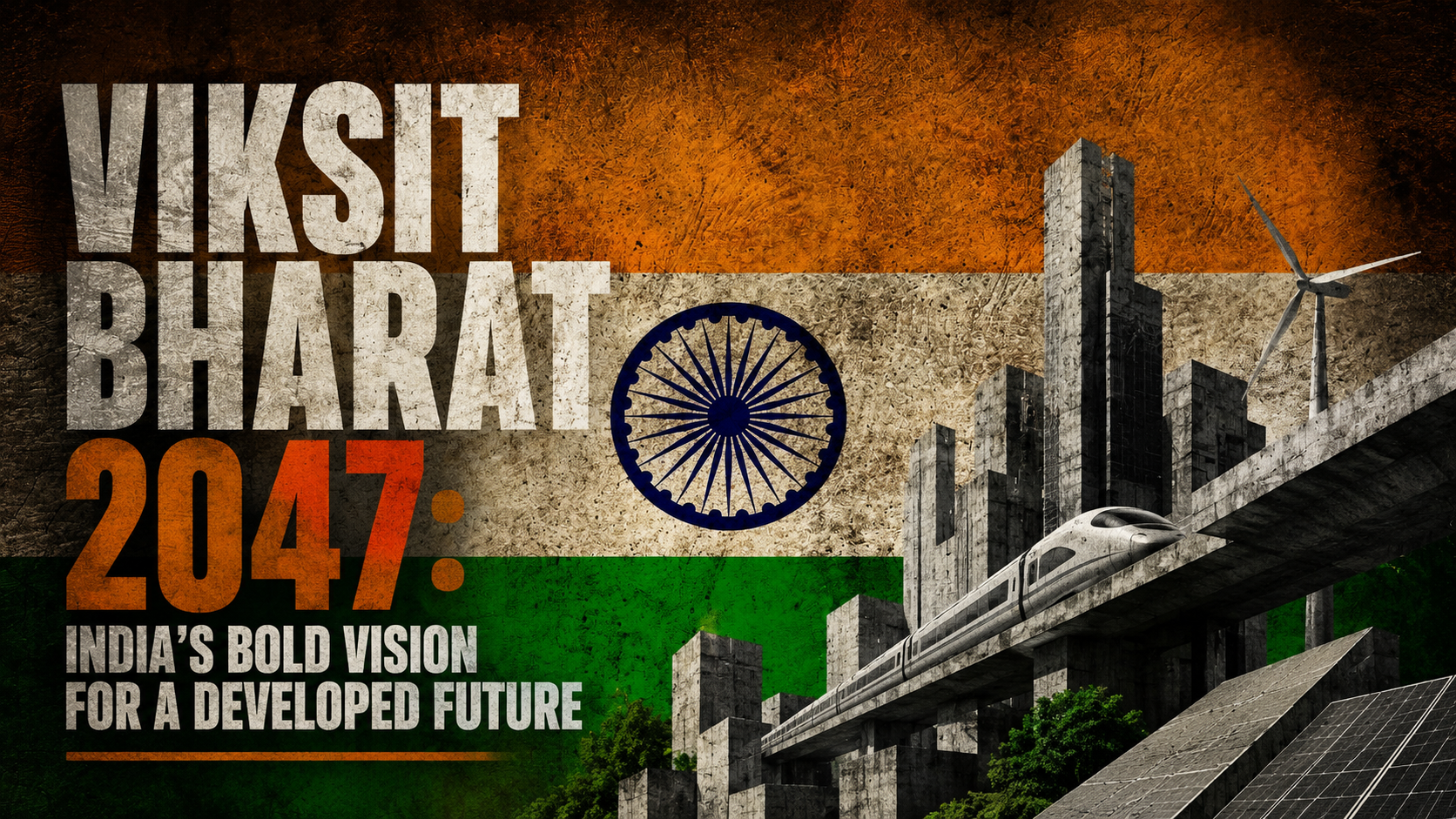
Viksit Bharat 2047
The aspiration behind Viksit Bharat is not limited to increasing GDP numbers or improving economic rankings globally. The idea is far broader. It aims to build an India that is economically strong, socially inclusive, technologically advanced, environmentally sustainable, and institutionally resilient.
The vision is ambitious, but it also reflects the scale of transformation India has already witnessed over the last three decades. From becoming one of the world’s fastest growing major economies to emerging as a global technology and digital infrastructure leader, India today possesses both the demographic and economic potential to attempt such a transformation seriously.
The term “developed nation” is often misunderstood as purely an economic classification. In reality, development involves multiple dimensions.
A developed country is generally expected to demonstrate:
Therefore, the success of Viksit Bharat cannot be measured only through GDP expansion. The real success will depend on whether economic growth translates into better quality of life, reduced inequality, stronger opportunities, and improved human development for ordinary citizens.
This is why the Viksit Bharat framework focuses simultaneously on economic growth, social progress, governance reforms, sustainability, innovation, and citizen empowerment.
The central objective of Viksit Bharat is to transform India into a fully developed nation by the year 2047, coinciding with the centenary of independence.
Economically, India aims to become a multi trillion dollar economy with significantly higher per capita income levels. Different projections suggest targets ranging between USD 30 trillion and USD 40 trillion by 2047. Achieving this scale would place India among the world’s leading economic powers.
However, the vision goes beyond economics alone.
The initiative also focuses on:
The broader objective is to ensure that development remains inclusive rather than concentrated within a limited section of society.
The government has identified several major pillars central to achieving the Viksit Bharat vision. These include youth, women, farmers, and economically weaker sections of society.
India’s demographic structure plays a major role here. With one of the world’s largest youth populations, India possesses a potential workforce capable of driving long term growth for decades. However, demographic advantage alone does not guarantee success.
The challenge lies in:
Without improvements in these areas, demographic potential can quickly become demographic pressure.
Similarly, women’s participation in education, entrepreneurship, leadership, and workforce development will significantly influence India’s future growth trajectory. Inclusive development cannot occur if large sections of society remain economically underrepresented.
Agriculture also remains central to the Indian economy despite rapid urbanisation. Ensuring agricultural productivity, rural development, and farmer welfare continues to remain a major component of long term national stability.
No country can realistically achieve developed nation status without large scale infrastructure expansion.
This is one of the strongest focus areas under the Viksit Bharat framework.
India is currently witnessing major investment in:
The PM Gati Shakti initiative reflects this larger approach toward integrated infrastructure development.
Digital infrastructure has become particularly important in India’s development model. India’s digital public infrastructure systems including Aadhaar, UPI, and Direct Benefit Transfer mechanisms have already gained international attention for their scale and efficiency.
The expansion of internet connectivity, digital literacy, and technology based governance systems is expected to play a major role in improving both economic productivity and governance delivery.
One of the biggest challenges India faces is transitioning from a service dominated economy toward stronger manufacturing capacity.
Countries that achieved developed nation status historically built strong industrial and manufacturing foundations alongside services growth.
This explains the strategic importance of initiatives like:
India aims to strengthen domestic manufacturing capability across sectors such as:
Manufacturing expansion is essential not only for GDP growth but also for large scale employment generation.
At the same time, exports will remain critical. A country aspiring to become a major economic power must increase its global competitiveness across manufacturing, services, and technology sectors.
Economic growth alone is insufficient without efficient governance systems.
Ease of doing business, regulatory transparency, policy consistency, judicial efficiency, and institutional credibility all influence long term development outcomes.
This is why governance reforms remain an important part of the Viksit Bharat framework.
Digital governance initiatives, reduction in bureaucratic delays, transparency mechanisms, and technology enabled public service delivery systems are all aimed at improving administrative efficiency and reducing corruption.
The broader objective is to build systems that are:
Strong institutions ultimately create stronger developmental stability.
While the Viksit Bharat vision is ambitious and achievable in several respects, the path remains extremely challenging.
India still faces major structural issues including:
Climate change itself poses long term developmental risks, particularly for agriculture, water availability, and urban sustainability.
Another major challenge lies in maintaining consistently high economic growth rates over multiple decades. Experts estimate that India may require sustained annual growth rates near 7 to 8 percent for prolonged periods to realistically achieve developed nation status by 2047.
Such sustained growth requires continuous reforms, investment confidence, political stability, institutional efficiency, and global competitiveness.
One important aspect of Viksit Bharat is the emphasis on public participation.
The vision cannot be achieved through government policy alone. Long term national transformation depends heavily on the participation of:
This is why initiatives encouraging youth participation, innovation, entrepreneurship, and public contribution have become increasingly important.
Development at this scale requires both institutional planning and societal responsibility.
Viksit Bharat 2047 represents one of the most ambitious national transformation visions in independent India’s history.
The scale of the challenge is enormous, but so is the scale of opportunity.
India possesses several long term strengths:
However, achieving developed nation status will ultimately depend on whether growth remains sustainable, inclusive, and institutionally supported over the next two decades.
The success of Viksit Bharat will not be measured only by economic rankings or trillion dollar figures. Its true success will depend on whether ordinary citizens experience:
The journey toward becoming a developed India is not simply an economic target. It is a long term civilisational project that will require discipline, reforms, innovation, institutional strength, and collective national effort sustained consistently over decades.
KISS rule - Keep It Simple Stupid everywhere in your life
— Lt. Cdr. Nikhil Kumar Chandrakala (Retd.)