Blog Details
Detailed view of the selected blog post.

Detailed view of the selected blog post.
Consistency is often the biggest challenge in the SSB process because candidates are observed continuously across different tasks, situations, and pressures over five days. The assessment is not about giving perfect answers or performing well in one activity, but about showing genuine personality traits, leadership potential, emotional stability, and clear decision-making throughout the process. This is also why rehearsed behaviour and memorized responses become easy to identify during assessment.
Time: 07 min
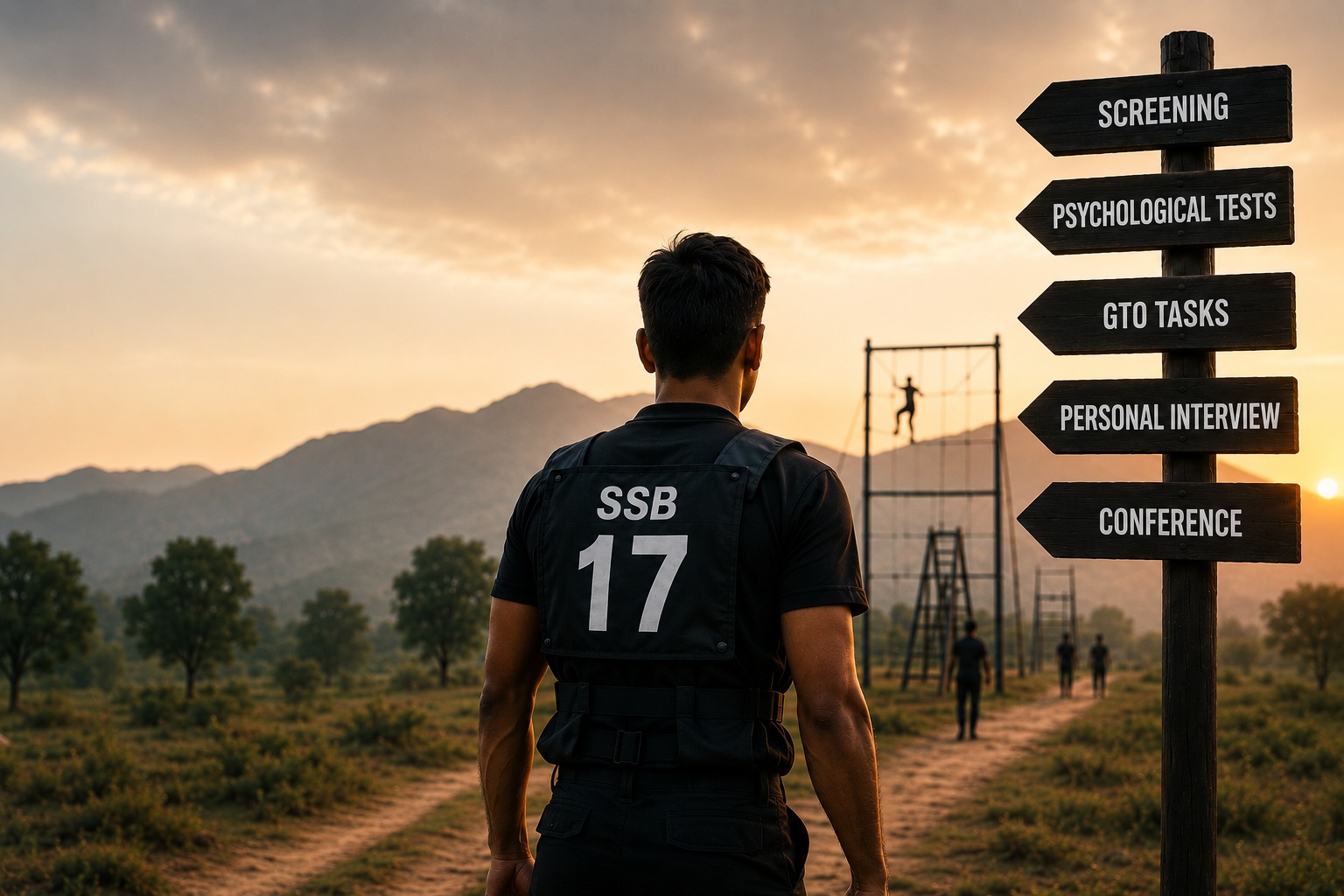
What is the toughest part of SSB?
Every SSB candidate enters the selection process believing that one particular task is the “hardest.” For some, it is Psychology. For others, it is the Personal Interview. Many fear the Conference because of its unpredictability. A few believe Group Testing is where maximum candidates fail.
But from an assessor’s perspective, the toughest part of SSB is usually not a particular task.
The toughest part is maintaining consistency of personality across all five days.
This is where the majority of candidates struggle without even realising it.
SSB is not designed as a knowledge examination. It is a behavioural assessment system. The purpose is not to identify who speaks the best English, who has the most polished personality, or who has memorised the maximum “officer like” responses. The purpose is to evaluate whether the candidate’s natural personality demonstrates the potential to be trained as a military leader.
That is why the same candidate is observed repeatedly in different environments, under different pressures, by different assessors.
And this is exactly where consistency becomes difficult.
Most candidates prepare for SSB by focusing on individual tasks separately.
The problem is that SSB is designed specifically to detect artificial projection.
The psychologist, interviewing officer, and GTO are not working independently in isolation. They are evaluating the same personality from different angles.
A candidate may project confidence in the interview, but show poor initiative during group tasks.
Another candidate may write highly idealistic psychological responses, but display low social adaptability in discussions.
Some candidates attempt to appear aggressive because they misunderstand confidence. Others try to appear excessively calm and mature, which eventually starts looking rehearsed.
Over five days, inconsistencies begin surfacing naturally.
This is why assessors often say:
“Candidates do not get rejected because of one bad answer. They usually get rejected because their overall personality picture lacks clarity and consistency.”
Among all stages, Psychology is often perceived as the toughest because candidates cannot rely on surface level communication skills there.
The Psychological Tests are designed to capture spontaneous behavioural tendencies under time pressure.
In TAT, WAT, and SRT, candidates do not get enough time to consciously manufacture a completely artificial personality.
Their natural thought patterns begin appearing automatically.
This is why many candidates who speak confidently during interviews still struggle psychologically. The written responses may reveal hesitation, dependency, fear of responsibility, poor emotional balance, or unrealistic thinking patterns.
At the same time, candidates who are simple in communication but behaviourally clear often perform surprisingly well.
The psychologist is not searching for “perfect answers.” The psychologist is observing:
The challenge is that these traits cannot be copied overnight.
Many candidates think the interview is a “question answer round.” It is not.
A skilled Interviewing Officer is trying to understand:
The toughest part for many candidates is not answering technical questions.
It is answering simple personal questions honestly and clearly.
Questions regarding failures, weaknesses, family dynamics, friendships, responsibilities, habits, and life decisions often expose lack of self awareness very quickly.
Candidates who attempt to create a fake image usually become inconsistent after prolonged interaction.
Experienced assessors have interacted with thousands of candidates over the years. They can usually identify exaggerated behaviour patterns relatively quickly.
The GTO series becomes difficult because candidates cannot control the environment there.
In psychology, candidates write responses individually.
In interviews, interaction happens one to one.
But in GTO tasks, multiple personalities compete simultaneously under pressure, uncertainty, time constraints, and group dynamics.
This is where natural behaviour emerges.
Some candidates dominate unnecessarily.
Some disappear completely.
Some stop listening to others.
Some focus only on appearing active instead of helping the group progress.
The GTO is not looking for the loudest speaker or the physically strongest candidate. The GTO is observing:
A candidate who helps the group move forward calmly and consistently usually creates a stronger impression than someone trying aggressively to “lead” every task.
The Conference round creates anxiety mainly because candidates do not fully understand its purpose.
For most candidates, the Conference is usually a confirmation stage rather than a fresh assessment stage.
The board discusses whether the overall personality picture created over five days is clear enough for recommendation.
Borderline cases naturally receive deeper discussion.
This is why some conferences last longer than others.
Many candidates assume that a long conference means recommendation or rejection. In reality, conference duration alone proves nothing reliably.
The actual challenge is not the Conference itself.
The challenge is whether the candidate has maintained a stable and believable personality picture throughout all previous assessments.
From an assessor’s perspective, the toughest thing for candidates is remaining natural while constantly feeling observed.
Most candidates become performance oriented after entering the SSB environment.
Instead of responding naturally, they begin thinking:
This mental filtering creates unnatural behaviour patterns.
Ironically, candidates who try too hard to appear officer like often become less authentic.
The SSB process is intentionally long because personality masks become difficult to maintain continuously for five days.
Natural behaviour eventually surfaces.
That is why genuine preparation for SSB is not about memorising responses.
It is about improving:
There is no single “toughest task” in SSB for everyone.
A candidate weak in communication may fear the interview.
A candidate with poor emotional structure may struggle psychologically.
A candidate lacking social adaptability may find GTO difficult.
But overall, the toughest challenge remains the same:
Maintaining consistency between what you think, what you say, what you write, and how you behave.
That consistency cannot be developed through shortcuts.
It develops through genuine personality growth, responsibility in daily life, clarity of thought, and practical exposure to real situations.
At SSBwithISV, one of the biggest focus areas during mentoring is helping candidates identify behavioural inconsistencies early rather than teaching artificial responses. Long term success in SSB does not come from acting like an officer for five days. It comes from gradually developing the qualities that naturally reflect officer potential.
KISS rule - Keep It Simple Stupid everywhere in your life
— Lt. Cdr. Nikhil Kumar Chandrakala (Retd.)