
Blog Details
Detailed view of the selected blog post.

Detailed view of the selected blog post.
Being an SSB repeater is not a weakness if you learn from your previous attempts. Repeaters should focus on understanding their mistakes, improving self awareness, and avoiding artificial preparation or memorised responses. Every attempt is a new opportunity to show growth in personality, confidence, communication, and officer like qualities. Read the full blog to understand what every SSB repeater should keep in mind before the next attempt.
Time: 07 min
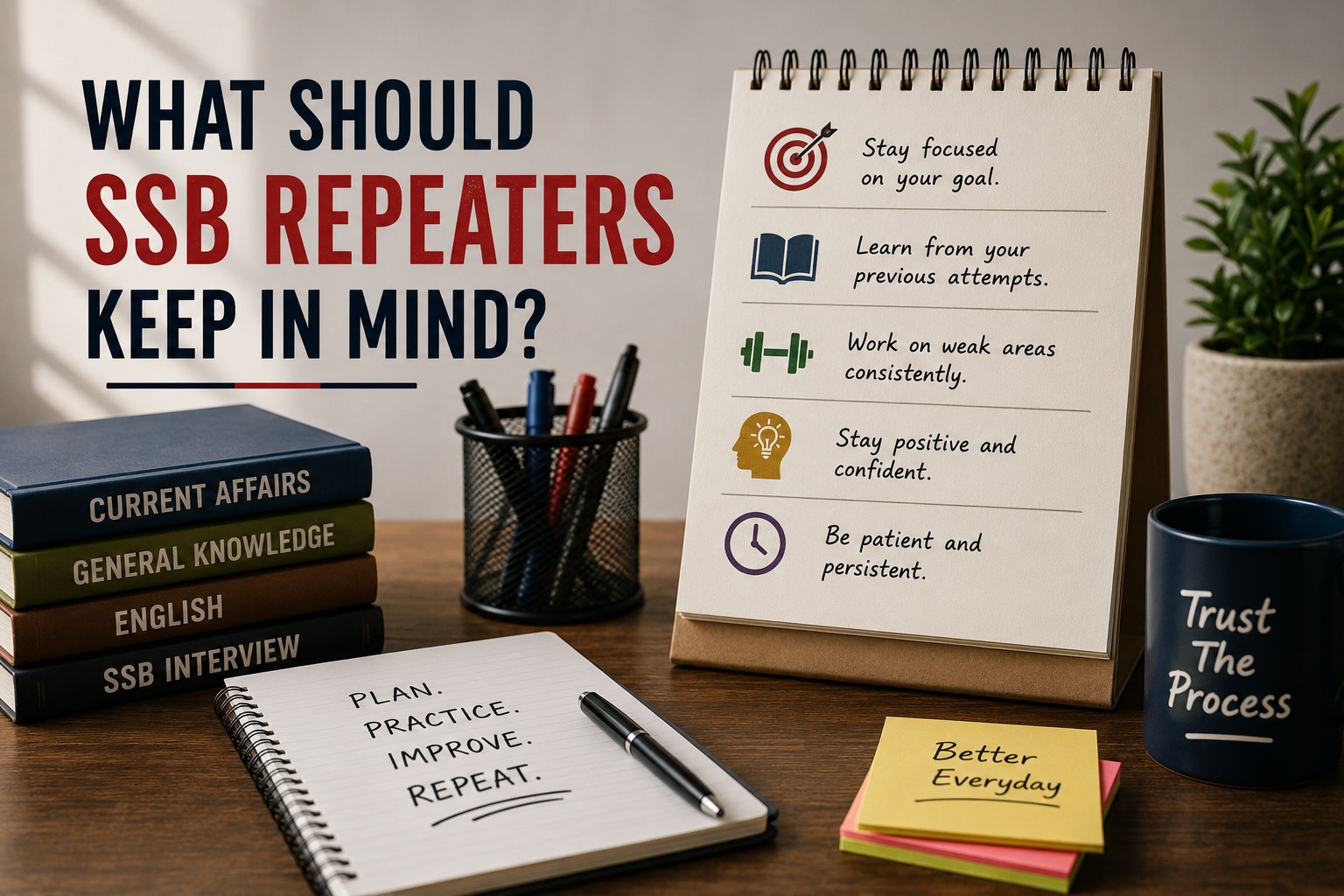
What should SSB repeaters keep in mind?
One of the biggest misconceptions surrounding the SSB process is that repeaters automatically have an advantage over freshers. On the other hand, many repeaters themselves begin believing that repeated recommendations become impossible after multiple attempts.
Both assumptions are inaccurate.
The reality is much more balanced.
Being a repeater neither guarantees success nor guarantees rejection. What truly matters is whether the candidate has evolved meaningfully between attempts.
From an assessor’s perspective, the most important question is not:
“How many attempts has this candidate given?”
The real question is:
“What has changed in this candidate since the last attempt?”
This is where many repeaters unknowingly struggle.
Most repeaters prepare harder after a screen out or conference out.
Very few prepare smarter.
After an unsuccessful attempt, candidates often react emotionally instead of analytically. They start collecting more “tips,” memorising more model responses, watching excessive online content, and trying to modify surface level behaviour.
Unfortunately, this usually creates a more artificial personality instead of a clearer one.
Many repeaters begin overthinking every task:
This performance oriented mindset often damages spontaneity.
Ironically, candidates who attempt to appear “more officer like” after previous failures sometimes become less natural than they were during their first attempt.
Giving multiple attempts alone does not automatically improve SSB performance.
A candidate may attend three, five, or even ten SSBs while repeating the same behavioural patterns every time.
If there is no proper self analysis, the same weaknesses usually continue appearing across attempts.
Some common examples include:
Many repeaters continue focusing only on task practice without understanding the behavioural issue underneath.
This is why genuine self assessment becomes extremely important after every attempt.
A screen out does not mean the candidate lacks officer potential permanently.
Stage 1 is designed as a filtering mechanism under limited observation time.
Sometimes candidates struggle because of:
Many recommended candidates today were screened out in earlier attempts.
The important thing is to identify what exactly went wrong instead of emotionally concluding:
“I am not fit for SSB.”
That conclusion is usually inaccurate and psychologically damaging.
Conference out cases are usually more complex because the candidate has already survived multiple layers of assessment.
In many conference out cases, assessors may have observed:
Conference outs often happen when the assessors do not get a completely convincing and consistent personality picture.
This means repeaters should avoid simplistic conclusions such as:
SSB assessment is not isolated task based marking.
The final recommendation depends on the overall personality picture emerging collectively across all assessments.
One of the most harmful patterns among repeaters is excessive exposure to copied content.
After repeated attempts, many candidates start collecting:
This creates mental clutter.
Eventually, candidates stop responding naturally and begin internally filtering every response.
The problem is that SSB assessors are experienced in identifying rehearsed behavioural patterns.
Psychological consistency becomes difficult when responses are heavily manufactured.
The objective of preparation should not be:
“How do I impress assessors?”
The objective should be:
“How do I improve clarity, maturity, responsibility, and behavioural consistency?”
That shift changes preparation quality completely.
One major difference between successful repeaters and unsuccessful repeaters is this:
Successful repeaters improve their real life functioning between attempts.
Unsuccessful repeaters often remain trapped only inside preparation cycles.
Assessors do not evaluate preparation effort alone. They evaluate personality development.
Candidates who gradually improve:
naturally begin reflecting stronger officer potential.
Real life experiences strengthen personality far more effectively than memorised preparation material.
Repeated failures affect confidence levels deeply.
Some repeaters become overly desperate for recommendation. Others become emotionally exhausted and cynical toward the process.
Both extremes are dangerous.
Candidates must understand that SSB is not a measure of personal worth. It is a suitability based assessment system for a specific role under a specific environment.
Not getting recommended in one or multiple attempts does not automatically mean the candidate lacks capability in life.
At the same time, emotional frustration should not become an excuse to avoid self improvement.
The healthiest approach is balanced reflection:
One of the fastest ways repeaters lose confidence is comparison.
Candidates often compare themselves with:
This comparison creates unnecessary pressure.
Different candidates mature differently.
Some candidates naturally possess stronger behavioural alignment earlier.
Others require more time, exposure, maturity, and personality development.
SSB preparation should never become a race of attempt numbers.
Contrary to popular fear, assessors do not automatically view repeaters negatively.
In fact, repeaters who demonstrate:
often leave strong impressions.
What assessors dislike is visible artificiality developed through excessive coaching dependence or rehearsed projection.
A repeater who appears natural, grounded, self aware, and behaviourally consistent is always taken seriously.
Every unsuccessful attempt should ideally produce one of two outcomes:
If repeated attempts only increase anxiety, artificial behaviour, and overthinking, preparation direction usually needs correction.
SSB is not conquered through memorisation.
It is navigated through personality clarity, behavioural consistency, social effectiveness, emotional maturity, and practical thinking developed gradually over time.
At SSBwithISV, repeater mentoring focuses heavily on identifying behavioural gaps, inconsistent personality patterns, and over conditioned responses that often develop after multiple attempts. The objective is not to manufacture officer like behaviour artificially, but to help candidates develop genuine clarity, maturity, and natural leadership qualities that can sustain consistently throughout the assessment process.
KISS rule - Keep It Simple Stupid
— Lt. Cdr. Nikhil Kumar Chandrakala (Retd.)