
Blog Details
Detailed view of the selected blog post.

Detailed view of the selected blog post.
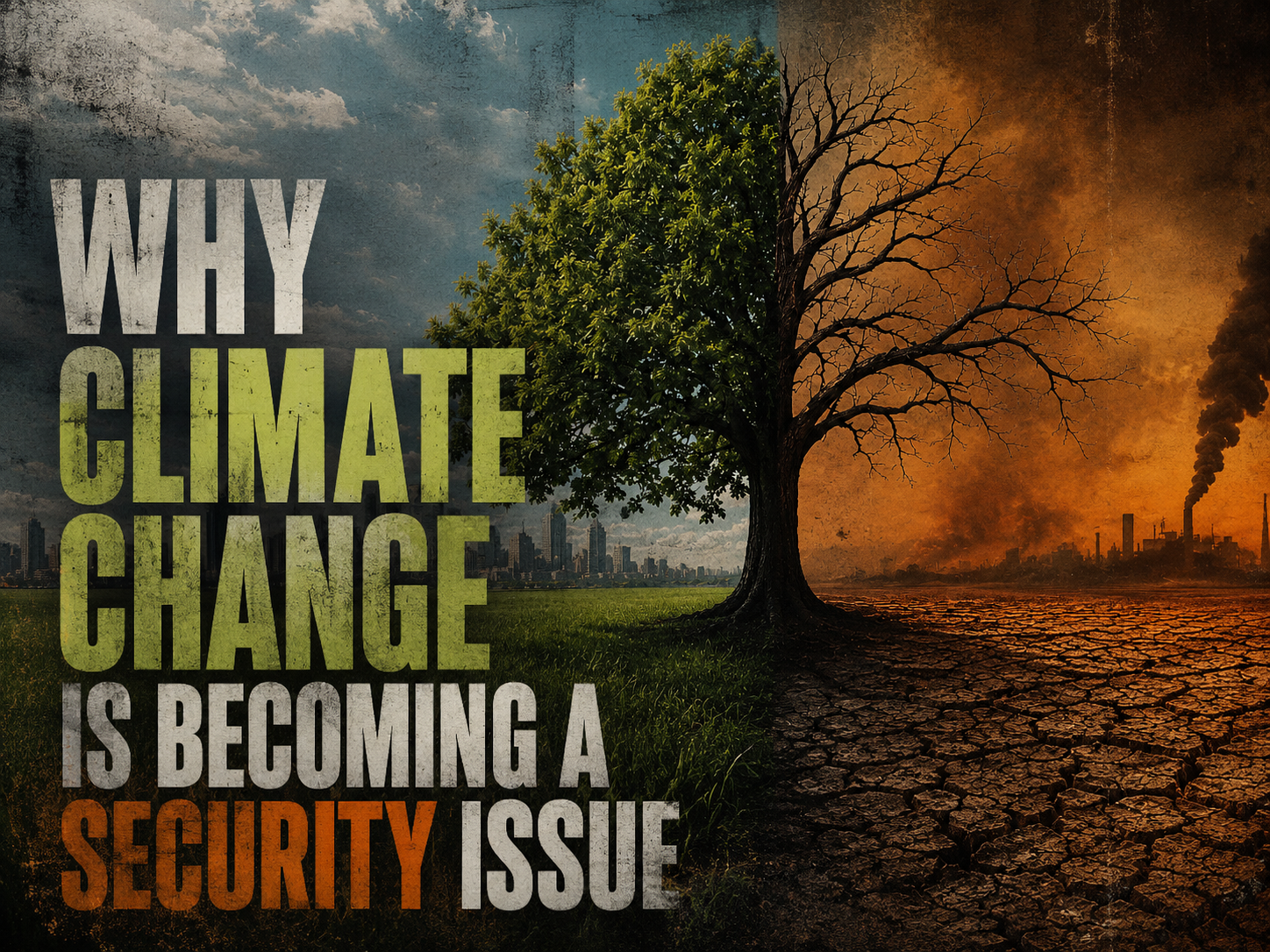
Climate change has evolved from an environmental issue into a critical global security challenge. Acting as a "threat multiplier," it intensifies existing social, economic, and political tensions by driving food and water scarcity, triggering mass climate migration, and straining urban infrastructure. Modern militaries now treat it as a strategic risk that disrupts operational readiness and increases the need for disaster relief. For nations like India, climate impacts heavily threaten agriculture and urban stability, redefining modern national security as a complex mix of border defense, resource management, and environmental resilience.
Time: 08 min
Climate change
For a long time, climate change was discussed mainly as an environmental problem. Most conversations focused on rising temperatures, melting glaciers, pollution, or extreme weather conditions.
Today, that understanding is changing rapidly.
Governments, militaries, and international organisations across the world increasingly recognise that climate change is also becoming a major security challenge. It affects not only the environment, but also food security, water availability, migration patterns, economic stability, public health, and even geopolitical tensions.
In many parts of the world, climate change is no longer viewed as a distant future problem. Its effects are already influencing societies, economies, and national security systems in real time.
Climate change itself may not directly start wars or conflicts, but it can increase pressure on already fragile systems.
For example:
When such pressures combine with poverty, weak governance, unemployment, or political instability, the chances of conflict and unrest often increase.
This is why climate change is now increasingly called a “threat multiplier.” It does not create every problem independently, but it can intensify existing social, economic, and political tensions.
One of the biggest climate related risks involves access to water and food.
Many regions across the world already face water stress due to rising temperatures, irregular rainfall, and changing weather patterns. Agriculture becomes difficult when droughts, floods, or heatwaves affect crop production repeatedly.
For countries with large populations, this creates serious long term concerns.
Food shortages, rising prices, and agricultural disruption can affect economic stability and public confidence. In regions already facing political or social tensions, such pressures may increase instability further.
This is why climate resilience is increasingly linked with national planning and security strategy.
Another major challenge emerging from climate change is migration.
Extreme weather conditions, floods, droughts, rising sea levels, and loss of livelihoods are forcing many communities to relocate. In some regions, entire populations may eventually face displacement risks due to environmental degradation.
Large scale migration creates pressure on:
When resources become limited, social tensions can increase.
This is one reason why climate change discussions today are closely connected with humanitarian planning and long term governance challenges.
Modern armed forces are increasingly recognising climate change as a strategic concern.
Extreme weather events can directly affect:
At the same time, armed forces are often among the first responders during floods, cyclones, earthquakes, and humanitarian crises.
As climate related disasters increase in frequency and intensity, militaries may face growing responsibilities in disaster management, rescue operations, humanitarian assistance, and infrastructure support.
Climate change is therefore becoming not only an environmental issue, but also an operational and strategic issue.
India is particularly vulnerable to climate related challenges because of its geography, population size, and economic diversity.
The country faces multiple risks including:
Agriculture, which still supports a large section of the population, remains highly dependent on climate conditions.
Rapid urbanisation also creates additional pressure on infrastructure and resource management. Cities increasingly face challenges related to:
This is why climate adaptation and environmental sustainability are becoming increasingly important for long term national planning.
Climate change is also influencing international relations.
Countries are increasingly competing and cooperating over:
Climate diplomacy has therefore become an important part of global politics.
At the same time, countries that fail to adapt effectively to environmental challenges may face economic and strategic disadvantages in the future.
This is one reason why sustainable development, renewable energy, and environmental resilience are receiving growing attention globally.
Climate change is often treated as just another current affairs topic for discussions or interviews.
In reality, it is a long term issue that will influence economics, security, governance, technology, and global stability for decades.
Understanding climate security helps develop:
It also encourages candidates to move beyond narrow definitions of security.
Modern security challenges are no longer limited only to traditional military threats. Increasingly, they include:
Future leaders may need to understand all of these dimensions together.
Climate change is gradually reshaping how countries think about national security and long term stability.
The challenge is no longer only about protecting the environment. It is about protecting societies, economies, infrastructure, and human security from increasing environmental pressure.
This requires long term planning, international cooperation, technological innovation, sustainable development, and responsible governance.
The countries that prepare early and adapt effectively are likely to remain more stable and resilient in the coming decades.
At SSBwithISV, discussions on contemporary issues are approached not only from an examination perspective, but also from the perspective of leadership awareness and balanced understanding. Topics such as climate security help aspirants develop broader thinking, practical awareness, and the ability to connect environmental, economic, and strategic issues together, qualities that are increasingly important in the modern world.
KISS rule - Keep It Simple Stupid
— Lt. Cdr. Nikhil Kumar Chandrakala (Retd.)