
Blog Details
Detailed view of the selected blog post.

Detailed view of the selected blog post.
The internet isn't powered by satellites alone. Hidden beneath the oceans lies a vast network that carries nearly all global data, making it one of the world's most critical yet overlooked infrastructures. Discover why these undersea cables matter, how they influence national security and geopolitics, and why they are becoming increasingly important for India's future.
Time: 08 min
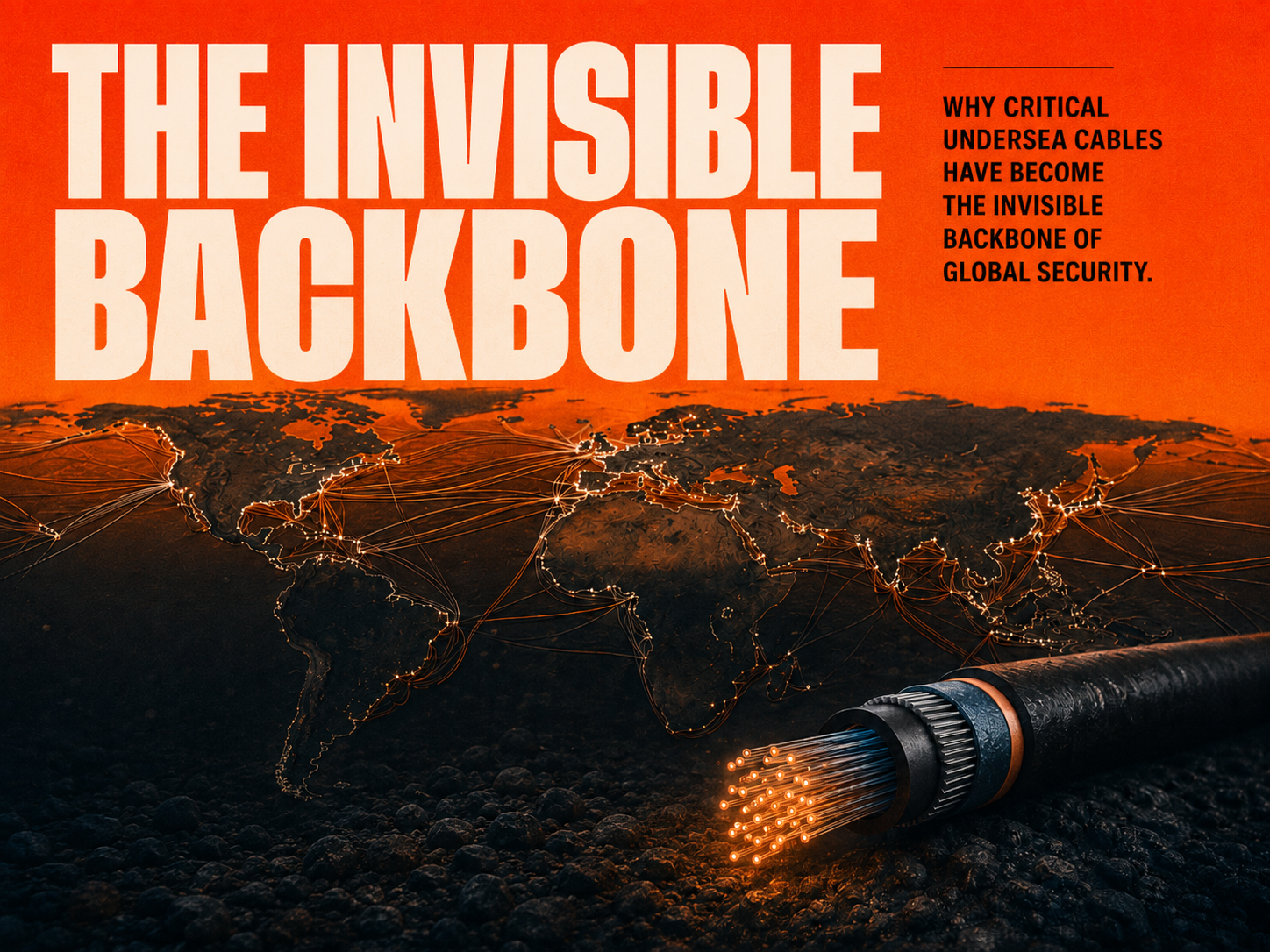
Why critical undersea cables have become the invisible backbone of global security
When people think about global communication, they usually imagine satellites orbiting the Earth, mobile towers, or wireless internet networks. Very few realize that the modern digital world depends heavily on infrastructure hidden deep beneath the oceans.
Every day, billions of messages, financial transactions, video calls, emails, military communications, and internet searches travel through a vast network of undersea fibre optic cables spread across the world's oceans.
These cables are largely invisible to the public, yet they form one of the most important pieces of global infrastructure.
In fact, more than 95 percent of international internet traffic is carried through submarine cable networks rather than satellites. This makes undersea cables one of the most critical components of the modern global economy.
Undersea cables are fibre optic communication lines laid across the seabed to connect countries and continents.
These cables transmit enormous amounts of data at extremely high speeds. They enable:
Without these cables, modern global connectivity would become significantly slower, more expensive, and far less reliable.
Although satellites play an important role in communication systems, they cannot currently handle the same volume of data carried by submarine cable networks.
This is why undersea cables remain the primary infrastructure supporting the global internet.
The modern economy runs on data.
Every time someone:
data is constantly moving across international networks.
Much of this movement depends on undersea cables.
Global businesses, stock exchanges, multinational corporations, and digital platforms all rely on uninterrupted data connectivity. Even a temporary disruption can affect financial markets, supply chains, and business operations across multiple countries.
In many ways, undersea cables have become as important to the modern economy as shipping routes were during earlier centuries.
The importance of undersea cables extends beyond economics.
They are also critical to cybersecurity.
Since such a large portion of global communication passes through these networks, protecting them has become a major security concern for governments around the world.
Potential risks include:
A successful attack on major cable infrastructure could disrupt communications, affect businesses, and create significant economic consequences.
As countries become increasingly dependent on digital systems, the protection of communication infrastructure has become an essential part of national security planning.
The growing strategic importance of undersea cables has attracted the attention of major powers.
Countries are increasingly recognizing that communication networks are not just commercial assets. They are strategic assets.
Control over critical infrastructure can influence:
This has led to growing discussions around:
As geopolitical competition increases, undersea cable networks are becoming part of broader strategic calculations.
Governments are paying closer attention to who builds, owns, operates, and secures these systems.
Military operations today depend heavily on information.
Modern armed forces require secure communication systems for:
Any disruption to communication networks can affect military effectiveness.
This is one reason why undersea cable security has become an important concern for defence planners globally.
The issue is not simply about protecting internet access. It is about protecting the communication infrastructure that supports national decision making and operational readiness.
As military systems become increasingly network driven, communication resilience becomes just as important as physical capability.
One of the unique challenges associated with undersea cables is their geography.
Thousands of kilometers of cable lie across vast ocean floors. Monitoring every section continuously is extremely difficult.
While cable damage can occur naturally due to earthquakes, fishing activities, or maritime accidents, there are also concerns regarding intentional interference.
Recent incidents in different parts of the world have highlighted how vulnerable critical infrastructure can be.
As awareness of these vulnerabilities grows, governments and international organizations are exploring ways to strengthen monitoring, resilience, and redundancy within cable networks.
The goal is to ensure that communication systems can continue functioning even if disruptions occur.
India's digital economy is expanding rapidly.
The country depends increasingly on:
As one of the world's largest digital economies, India has a strong interest in maintaining secure and reliable communication networks.
The Indian Ocean region also hosts several important submarine cable routes connecting Asia, Europe, Africa, and the Middle East.
Protecting these routes is therefore relevant not only from an economic perspective but also from a strategic and security standpoint.
As India's digital footprint continues growing, undersea cable security is likely to become an increasingly important policy issue.
Most people never think about undersea cables while sending messages, attending online meetings, making payments, or browsing the internet.
Yet these activities depend on a global network quietly operating beneath the oceans every second of every day.
This hidden infrastructure supports:
Its importance becomes most visible only when disruptions occur.
As the world becomes more connected and data dependent, protecting undersea cable networks will become just as important as protecting ports, airports, highways, and power grids.
The story of undersea cables highlights how modern security challenges are evolving.
In earlier eras, national security discussions focused primarily on borders, military forces, and physical infrastructure. Today, digital infrastructure has become equally important.
A single fibre optic cable running across the ocean may not attract the same attention as a warship or a fighter aircraft, but its role in supporting communication, commerce, and security is enormous.
Understanding such topics helps reveal how technology, geopolitics, economics, and national security are increasingly interconnected. The future security environment will not be shaped only by visible assets. It will also depend on protecting the critical systems that quietly enable modern societies to function every day.
At SSBwithISV, discussions on contemporary issues often focus on developing the ability to analyze topics beyond their surface appearance. Understanding how seemingly invisible infrastructure can influence economics, strategy, and security helps aspirants build the broader perspective expected from future military leaders and decision makers.
KISS rule - Keep It Simple Stupid
— Lt. Cdr. Nikhil Kumar Chandrakala (Retd.)