
Blog Details
Detailed view of the selected blog post.

Detailed view of the selected blog post.
For decades, India’s security discussions were largely centred around land borders and conventional military threats. But the strategic reality of the modern world is changing rapidly. Today, the oceans are becoming just as important as land borders in shaping national security, economic stability, and geopolitical influence. This changing reality is clearly reflected in the Indian Maritime Doctrine 2025.
Time: 08 min
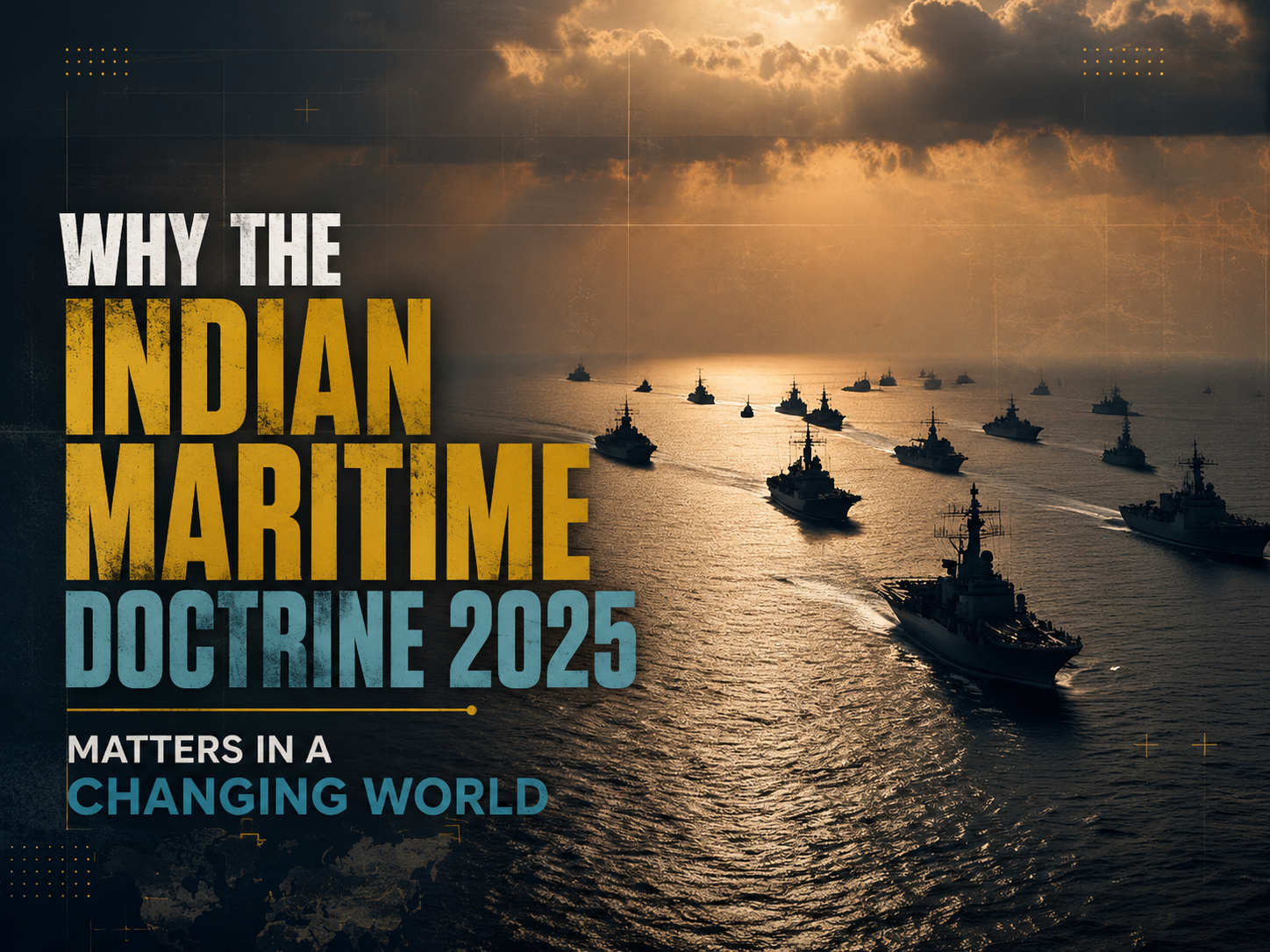
Why the Indian Maritime Doctrine 2025 matters in a changing world
The doctrine shows how India increasingly views the maritime domain not only as a naval space, but as a strategic environment directly connected to trade, technology, energy security, regional influence, and future warfare. In many ways, it reflects how India is preparing itself for a more interconnected and competitive global environment.
India’s geography gives the Indian Ocean enormous strategic importance. A large percentage of global trade and energy transportation passes through this region. For India specifically, maritime routes are essential for:
Any disruption in the Indian Ocean can directly affect national interests.
This is why maritime security is no longer viewed as only the Navy’s responsibility. It is increasingly linked with economic stability, diplomatic influence, and long term national growth.
The doctrine recognises that securing sea lanes, maintaining regional stability, and protecting maritime interests are now central to India’s broader strategic planning.
One of the most important shifts visible in recent years is the growing importance of the Indo-Pacific region.
Major global powers are increasing their presence in this region because it sits at the centre of global trade, technology routes, energy movement, and strategic competition. As geopolitical rivalries expand into maritime spaces, naval capability and maritime partnerships are becoming increasingly important.
The doctrine reflects India’s understanding that future strategic influence will depend not only on military strength, but also on maritime presence, partnerships, and regional stability.
This is why India has steadily expanded:
The focus is not simply on conflict preparation. It is also about maintaining balance and stability within a rapidly changing region.
One of the most important aspects of the doctrine is its recognition that future conflicts will not look like traditional wars alone.
Modern security challenges now involve:
This reflects how military strategy itself is evolving globally.
Naval power today is no longer limited to ships and submarines. Information systems, communication networks, intelligence integration, and technological capability are becoming equally important.
The doctrine highlights the need for India to modernise continuously and prepare for multi domain security environments rather than isolated battlefield situations.
Technology is now deeply connected to military effectiveness.
Modern naval operations increasingly depend on:
Countries that fail to modernise technologically may struggle to maintain strategic effectiveness in future security environments.
This is why the doctrine places strong emphasis on technological adaptation and integrated operational capability. The future of maritime security will depend not only on physical assets, but also on information superiority and decision making speed.
Another important feature of the doctrine is the emphasis on cooperation and partnerships.
No single country can independently manage every maritime challenge in a region as large and strategically important as the Indo-Pacific. Piracy, maritime terrorism, illegal trafficking, cyber threats, and strategic instability often require coordinated responses.
India’s growing focus on joint exercises, interoperability, and maritime cooperation reflects this understanding.
At the same time, the doctrine also reinforces India’s intention to maintain strategic autonomy while protecting its national interests.
This balance between cooperation and independent capability is becoming increasingly important in modern geopolitics.
One important reality often ignored in public discussions is that maritime security directly affects economic growth.
A country dependent on international trade and energy imports cannot remain economically stable if maritime routes become insecure.
This is why naval strategy today is connected not only with defence planning but also with:
The doctrine reflects a broader understanding that military security and economic security are now deeply interconnected.
The Indian Maritime Doctrine 2025 is not simply a military document. It reflects how India views the future strategic environment.
It shows that national power in the modern world is no longer measured only through army size or territorial defence. Increasingly, it depends on:
The doctrine also highlights that future leadership, especially within defence and strategic sectors, will require broader understanding beyond conventional military thinking alone.
Officers and leaders operating in future environments may need to understand technology, geopolitics, cyber systems, maritime economics, and regional power dynamics together rather than separately.
The importance of the Indian Ocean and the Indo-Pacific region is likely to grow even further in the coming decades. As global trade, technology competition, and geopolitical rivalries intensify, maritime strategy will continue becoming a major pillar of national security.
The Indian Maritime Doctrine 2025 reflects India’s attempt to prepare for these future realities through modernisation, technological integration, strategic cooperation, and long term maritime planning.
For aspirants preparing for careers in the armed forces, topics like maritime doctrine and Indo-Pacific strategy are valuable not only because they appear in current affairs discussions, but because they help build strategic awareness and broader understanding of how modern security environments are evolving.
At SSBwithISV, defence and geopolitical discussions are approached with the objective of developing analytical thinking, clarity of thought, and balanced understanding rather than simply memorising information. Modern military leadership increasingly requires awareness of how technology, economics, strategy, and security interact together in shaping the future.
KISS rule - Keep It Simple Stupid everywhere in your life
— Lt. Cdr. Nikhil Kumar Chandrakala (Retd.)